






 725
725 


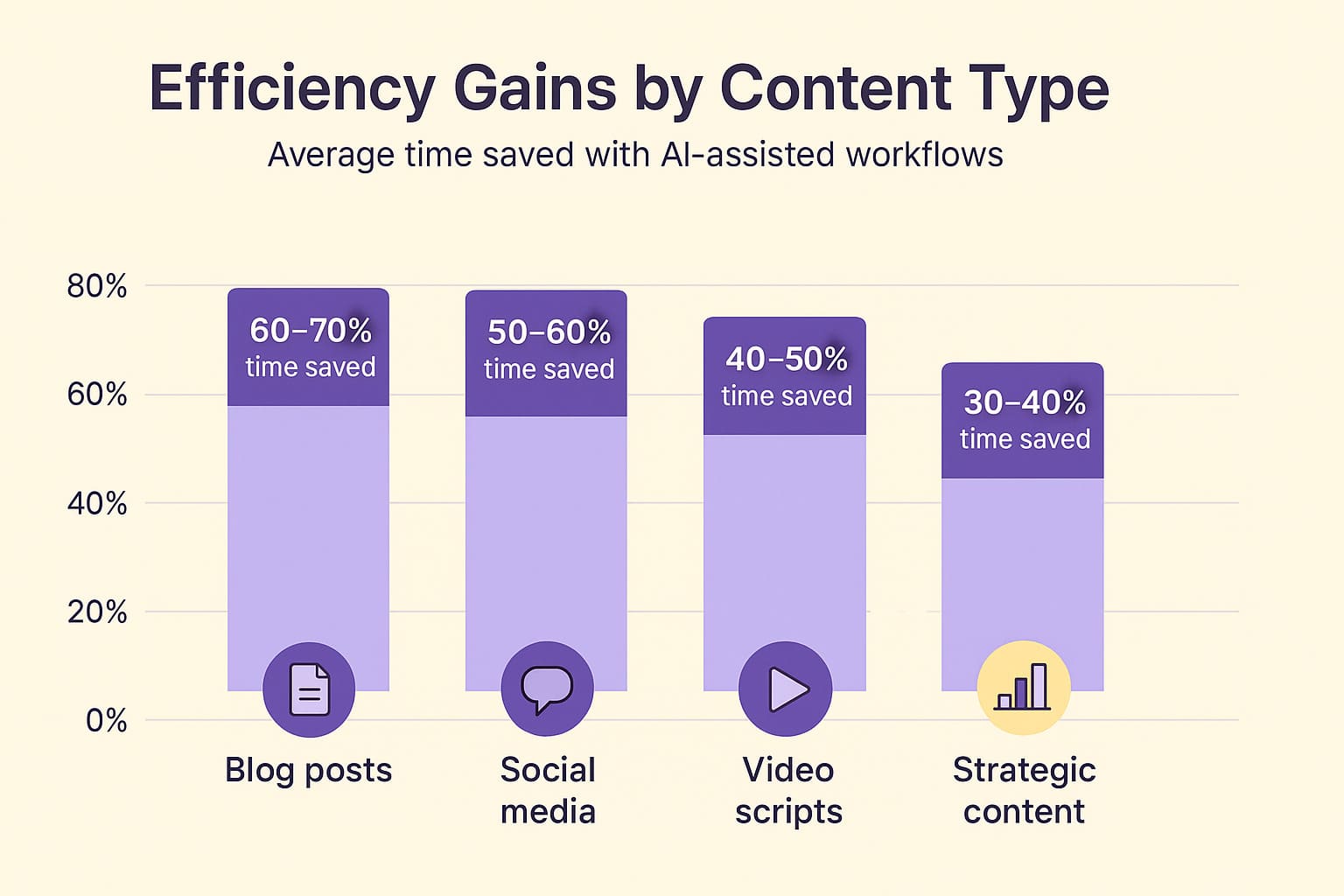
The way content gets created fundamentally changed. What used to consume entire workdays – drafting blog posts, scripting videos, writing social copy, generating voiceovers – now takes hours. Artificial intelligence technologies like GPT-4, Claude, and specialized platforms handle the mechanical heavy lifting across every content format: text, video, audio, graphics. Teams report 60-70% time reduction in first-draft creation. Not surprising that 90% of content marketers already use AI in 2025.
But here’s what separates results from chaos: strategic implementation. That means selecting tools that actually fit content goals ( $0-500 monthly), integrating them into existing workflows over 1-3 months, establishing quality checkpoints at every stage, and keeping human oversight exactly where it matters – brand voice, strategic direction, ethical compliance. The division of labor is clear: AI handles mechanical work, humans handle expertise, judgment, and authenticity.
Key benefits:
- 60-70% reduction in drafting time.
- Multi-format expansion.
- Maintained quality.
- Scalable personalization.
- Ethical framework.
Lead Craft’s generative engine optimization takes AI-created content further by optimizing entity definitions, semantic relationships, and citation structures for both traditional Google search and emerging AI platforms like ChatGPT, Perplexity, and Gemini.

- Understanding AI-Driven Content Strategy: Beyond the Buzzwords
- Types of AI Content Tools and Their Applications
- Integrating AI into Content Creation Workflows
- Common Challenges with AI-Driven Content Creation
- Best Practices for AI and Human Collaboration in Content
- The Future of AI in Content Marketing
- Getting Started: AI Content Creation Roadmap
- Conclusion: Embracing the AI-Content Revolution
- Frequently Asked Questions
Understanding AI-Driven Content Strategy: Beyond the Buzzwords
AI content creation uses generative AI models – GPT-4, Claude, and specialized platforms – to automate content production across text, video, audio, and visual formats. These machine learning algorithms trained on massive datasets predict the most likely next words based on patterns.
The common mistake: treating AI as complete human replacement or dismissing it as inadequate. Both fail. AI content tools serve as production accelerators – handling mechanical work while humans focus on strategy, brand voice, and unique insights.
The process: provide prompts, AI generates content from billions of training examples, humans refine outputs with expertise. These tools excel at structure and initial drafting but struggle with nuance and brand authenticity.
The Evolution of AI in Content Creation
OpenAI founded in 2015, released GPT-2 in 2018. GPT-3 arrived in 2020 with 175 billion parameters, generating coherent long-form content. Mainstream adoption exploded in November 2022 when ChatGPT launched, reaching 100 million users in two months.
By 2023, GPT-4 introduced multimodal capabilities. Anthropic launched Claude 3. The specialization wave followed – Jasper for marketing, Descript for video, ElevenLabs for voice. In August 2025, OpenAI released GPT-5 while Anthropic rolled out Claude 4.1.
Evolution Timeline:
- 2015: OpenAI founded.
- 2020: GPT-3 (175B parameters).
- 2022: ChatGPT (mainstream adoption).
- 2023: GPT-4 (multimodal), specialized tools.
- 2025: GPT-5, Claude 4.1.
From Manual to AI-Assisted Content Creation
Traditional content creation consumed entire days: 4 hours researching, 1 hour outlining, 5 hours drafting, 2 hours editing, 1 hour reviewing – 13 hours total. Quality was high but scalability impossible.
AI-assisted workflows changed this: Research drops to 2 hours. Outlining takes 15 minutes. Drafting shrinks to 3 hours (1 hour AI + 2 hours human). Review decreases to 45 minutes. Total: 6 hours – 54% time reduction.
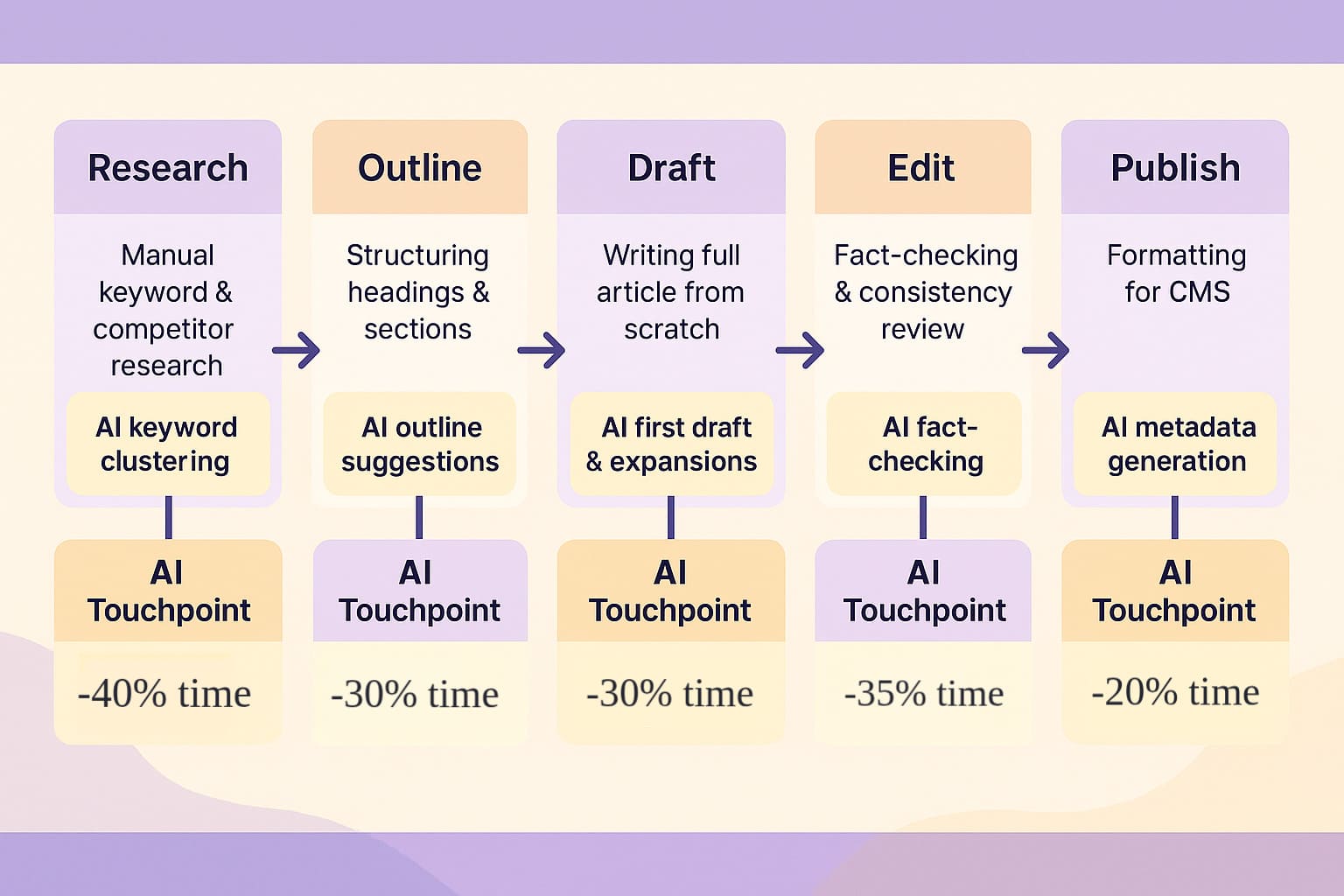
The shift reallocates human energy from mechanical production to strategic enhancement. Teams transform from content producers to strategists, editors, and quality directors.
Types of AI Content Tools and Their Applications
The AI content tool landscape divides into clear categories solving specific production challenges.
Text generation tools like ChatGPT and Claude create written content, achieving 70% time reduction. Enhancement platforms like Grammarly and Surfer SEO polish grammar and SEO, cutting editing 50%. Image tools like DALL-E reduce design time 60%. Video platforms like Synthesia slash video time 55%. Audio tools like ElevenLabs drop audio work 65%. Research tools like Semrush accelerate planning 40%.
AI Content Tool Categories:
| Tool Category | What It Does | Use Case | Impact | Example Tools |
|---|---|---|---|---|
| Text Generation | Creates written content | Blog drafts, social posts | 70% time reduction | ChatGPT, Jasper, Claude |
| Content Enhancement | Improves grammar, style, SEO | Polish drafts, optimize | 50% reduction | Grammarly, Surfer SEO |
| Image Creation | Generates visual content | Blog images, graphics | 60% reduction | DALL-E, Midjourney |
| Video Production | Scripts, edits, generates video | Tutorial videos, clips | 55% reduction | Synthesia, Pictory |
| Audio Creation | Text-to-speech, editing | Voiceovers, podcasts | 65% reduction | ElevenLabs, Descript |
| Research/SEO | Keyword research, analysis | Content planning | 40% faster | Semrush, MarketMuse |
Text Generation and Enhancement Tools
ChatGPT and Claude dominate text generation. ChatGPT leads with 77.9% selection rate among content marketers, though Claude produces cleaner outputs for complex topics.
For prompting, specificity wins. Generic prompts produce generic results. Detailed prompts specifying audience, tone, length, and structure generate better drafts. Maintaining a tested prompt library proves essential.
Enhancement tools layer on top. Grammarly catches grammar issues. Surfer SEO optimizes for search. Hemingway improves readability. HubSpot integrates AI content suggestions natively with SEO recommendations and user-friendly interfaces.
Top AI Text Tools:
- ChatGPT (OpenAI): Long-form drafts, research.
- Claude (Anthropic): Complex analysis, technical content.
- Jasper: Marketing copy with brand voice training.
- Grammarly: Grammar enhancement, tone adjustment.
- HubSpot: Native AI content suggestions, SEO.
Types of Content AI Can Generate
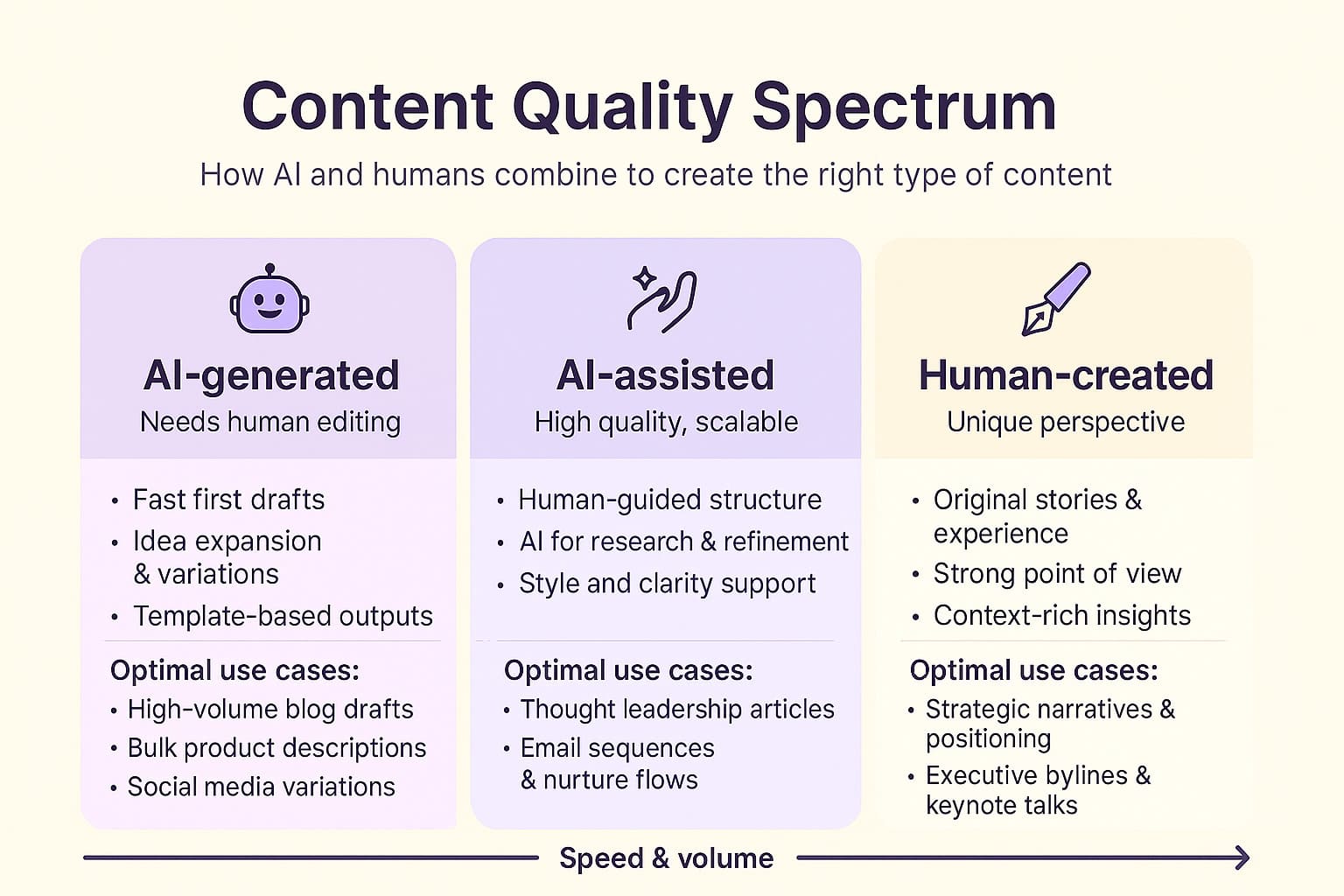
AI capabilities span wider than most realize. Blog posts achieve high effectiveness with 30% edit time. Social media reaches nearly publish-ready with 15% editing. Email marketing excels with 25% editing. Product descriptions scale perfectly with 10% oversight. Technical documentation needs 50% verification. Video scripts need 30% personality injection.
The pattern: AI effectiveness inversely correlates with required creativity. Formulaic content – AI handles brilliantly. Complex analysis – AI provides structure, humans provide substance.
Audio Content Creation with AI
Audio tools opened previously resource-prohibitive formats. ElevenLabs delivers ultra-realistic voice cloning across 29 languages with 90% human-like quality.
Descript revolutionized podcast editing with text-based timelines. Editing audio by editing text reduces editing time 70%. Pricing starts at $5/month.
Recommended AI Audio Tools:
- ElevenLabs: Ultra-realistic voice cloning (90% human-like).
- Descript: Text-based timeline, studio sound (70% reduction).
- Murf: 120+ voices, pronunciation control.
- Adobe Podcast: AI noise removal (free).
Video Content Generation and Editing
AI video tools collapsed traditional production barriers. Pictory converts blog posts into video presentations. Synthesia generates avatar-led videos without filming.
Video workflows transform: Concept 30 minutes. Script 1.5 hours. Voiceover 15 minutes versus 2 hours manual. B-roll 30 minutes versus 3 hours. Editing 1 hour versus 8 hours – 75% reduction. Total: 4.5 hours versus 16 hours – 72% reduction.
Research, SEO, and Content Planning with AI
AI-powered research accelerates strategic processes. Tools like Semrush, MarketMuse, and ChatGPT optimize topic identification and planning.
AI Research and Planning Process:
- Topic Discovery (Semrush + ChatGPT): Input seed keyword → AI generates 50+ topic ideas → Identify gaps (30min vs 4hrs manual).
- Keyword Research (Ahrefs + AI clustering): Export keywords → AI groups by intent → Prioritize → Generate briefs (1hr vs 6hrs).
- Competitor Analysis (Surfer SEO + Claude): Analyze top 10 → AI extracts themes → Identify missing elements → Create outline (45min vs 3hrs).
- Content Calendar (ChatGPT + Data): Feed historical data → AI suggests topics/timing → Generate 3-month calendar (2hrs vs 8hrs).
- Content Brief (MarketMuse + GPT-4): Input topic → AI generates comprehensive brief (30min vs 2hrs).
- Performance Prediction (Clearscope): Score content → AI predicts ranking → Adjust strategy (20min new capability).

Integrating AI into Content Creation Workflows
Integration determines success. Systematic workflow integration – AI touchpoints balanced with human oversight – multiplies effectiveness.
Workflows divide into four stages. Planning (traditional: 6 hours, AI: 2.5 hours, 58% reduction) uses Semrush plus ChatGPT for topics, Ahrefs for keywords, Surfer SEO for competitor review, MarketMuse for briefs.
Content creation (traditional: 8 hours, AI: 3 hours, 63% reduction) employs ChatGPT for structure, GPT-4 for drafts, then human fact-checking and voice refinement. Enhancement (traditional: 4 hours, AI: 2 hours, 50% reduction) applies Surfer SEO, Grammarly, DALL-E for images. Content management systems (CMS) like WordPress integrate AI plugins for workflow automation and multi-channel publishing.
Review (traditional: 2 hours, AI: 1.5 hours, 25% reduction) maintains human quality control with semi-automated CMS uploads.
Total: 20 hours traditional → 9 hours AI-assisted (55% reduction)
Case Study: Before and After Implementing AI
Before/After AI Implementation Metrics:
Production:
| Metric | Before AI (Q1 2023) | After AI (Q4 2024) | Change |
|---|---|---|---|
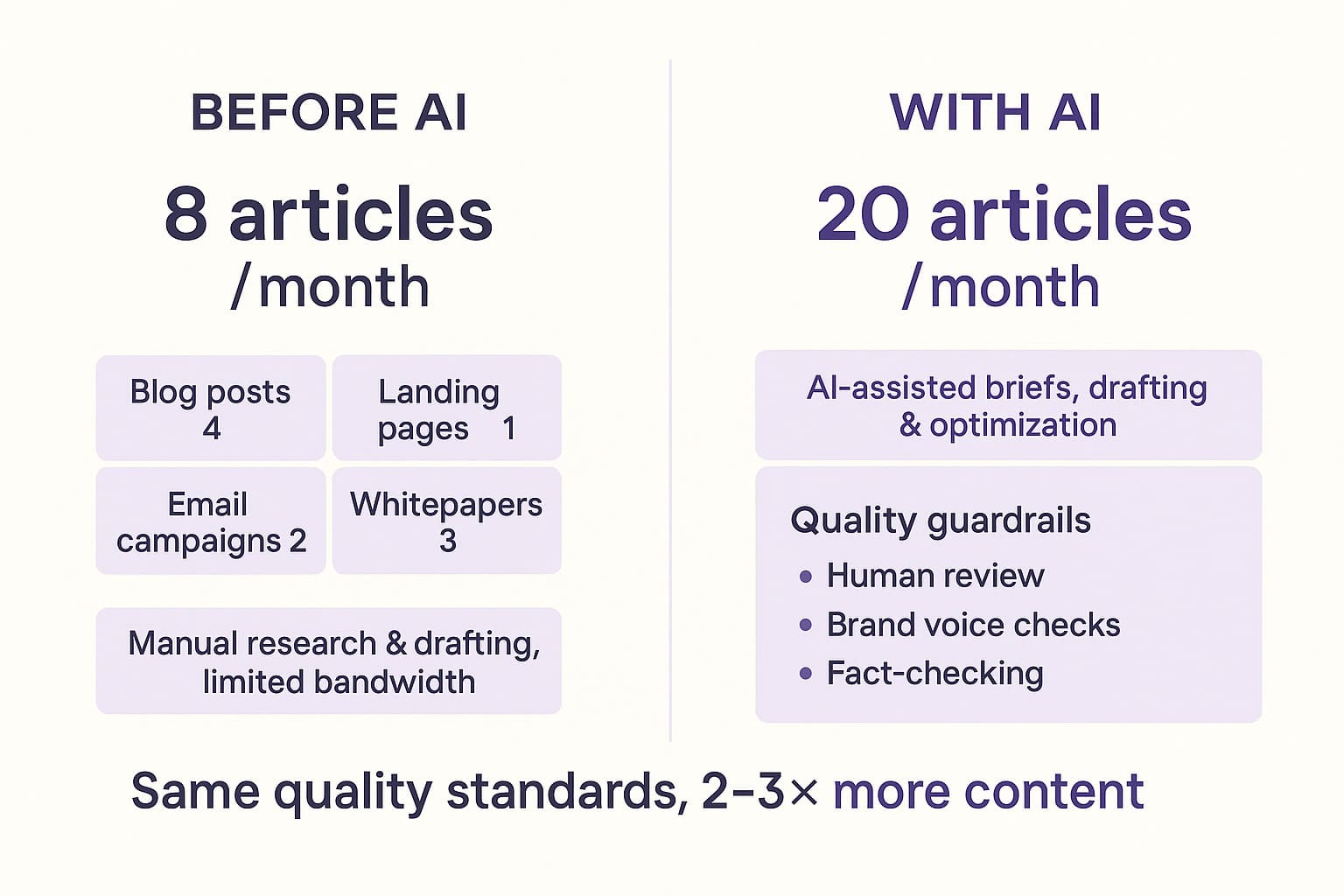
| Articles/Month | 8 articles | 22 articles | +175% |
| Time/Article | 20 hours | 9 hours | -55% |
| Content Formats | 2 (blog, email) | 6 (blog, email, video, audio, social, graphics) | +200% |
| Team Size | 3 FTE | 2 FTE + AI tools | -33% staff, +175% output |
Quality:
| Metric | Before AI (Q1 2023) | After AI (Q4 2024) | Change |
|---|---|---|---|
| Avg. Word Count | 1,200 words | 1,800 words | +50% |
| Readability Score | 65 (good) | 72 (very good) | +11% |
| SEO Score (Surfer) | 68/100 | 84/100 | +24% |
| Fact-Check Errors | 2-3 per article | 0-1 per article | -75% |
Performance:
| Metric | Before AI (Q1 2023) | After AI (Q4 2024) | Change |
|---|---|---|---|
| Organic Traffic | 12,500/month | 38,200/month | +205% |
| Avg. Time on Page | 2:15 | 3:45 | +67% |
| Conversion Rate | 2.1% | 3.8% | +81% |
| Social Engagement | 450 interactions | 1,680 interactions | +273% |
Cost:
| Metric | Before AI (Q1 2023) | After AI (Q4 2024) | Change |
|---|---|---|---|
| Cost per Article | $850 | $380 | -55% |
| AI Tool Costs | $0 | $220/month | New expense |
| Cost per 1K Visitors | $544 | $219 | -60% |
Key results: Quality improved alongside quantity, video/audio became viable without specialists, team morale increased, SEO exceeded expectations.
Common Challenges with AI-Driven Content Creation
AI solves problems but creates new challenges. Factual inaccuracies – AI stating incorrect information – demanded mandatory fact-checking, reducing errors from 15% to under 2%.
Generic output lacking perspective required brand voice prompts and human personality injection. Engagement improved 45% after refinement. Content similarity needed varied prompting and human expertise, increasing differentiation from 62% to 89% versus competitors. SEO over-optimization required readability checks, decreasing bounce rates 18%.
Common Challenges with Solutions:
Challenge 1: Factual Inaccuracies
- Problem: AI states incorrect information.
- Solution: Mandatory fact-checking, cross-reference claims.
- Impact: Reduced errors from 15% to <2%.
Challenge 2: Generic Output
- Problem: Content lacks unique perspective.
- Solution: Brand voice prompts, personality injection.
- Impact: Engagement improved 45%.
Challenge 3: Inconsistent Quality
- Problem: Same prompt produces varying quality.
- Solution: Quality scoring rubric, iterative prompting.
- Impact: Consistency improved 70%.
Maintaining Brand Voice and Authenticity with AI
Brand voice preservation requires a systematic approach. Create detailed guides documenting tone, vocabulary, sentence structure, and 10+ example paragraphs.
Train AI with 20+ existing content pieces using “write in the style of…” prompts. Develop custom prompts: “Write conversationally,” “Use active voice, short sentences.”
Human voice injection adds what AI cannot – personal anecdotes, unique perspectives, humor, emotion. Multi-stage review ensures AI draft → writer enhances → editor verifies.
Example transformation:
❌ Generic AI: “Implementing SEO best practices is essential for improving website visibility. Organizations should conduct keyword research and optimize on-page elements.”
✅ After Voice Injection: “Here’s the thing about SEO: it’s not about gaming Google. The sites that win actually help people. Sure, keyword research matters – but stuffing keywords into garbage wastes everyone’s time.”
Addressing Bias in AI Content Generation
AI models trained on internet data inherit biases – gender stereotypes, cultural assumptions, socioeconomic blind spots. Addressing bias requires systematic review.
Identify bias types: representation bias, cultural insensitivity, accessibility assumptions, socioeconomic bias, age stereotypes.
Review outputs asking: Are diverse perspectives included? Do examples reflect varied demographics? Is language gender-neutral where appropriate?
Implement mitigation: Use diverse training examples, request inclusive language, review through equity lens, test with diverse readers, maintain identification checklist. When bias appears, rewrite affected sections entirely.
Example corrections: ❌ “When a doctor enters, he should…” → ✅ “When a doctor enters, they should…” ❌ “Simply invest $50,000…” → ✅ “Consider investments matching your budget, whether $50 or $50,000…”
Data Privacy and Regulatory Considerations
Regulatory landscapes evolve rapidly. The EU AI Act requires strict documentation. California’s SB 942 (effective January 2026) mandates covered providers disclose AI-generated content.
PRSA updated AI ethics guidelines for 2025: “Clearly disclose when content is significantly influenced or generated by AI.”
Data privacy demands never inputting client confidential data into public AI tools, using enterprise versions with privacy guarantees, implementing data anonymization, training teams on acceptable sharing.
Critical: What NOT to Input into Public AI Tools:
- Customer PII (names, emails, addresses).
- Financial data (credit cards, bank accounts).
- Health information (medical records).
- Proprietary business data (strategies, financials).
- Legal documents (contracts, correspondence).
Safe Usage: Anonymize data, use hypotheticals, work with public information, or invest in enterprise AI tools with data protection SLAs.
Ethical Considerations and Content Transparency
Ethical AI content creation balances efficiency with integrity. Transparency about AI usage builds trust. Disclosure practices vary – some badge AI-assisted content, others detail methodology in about pages.
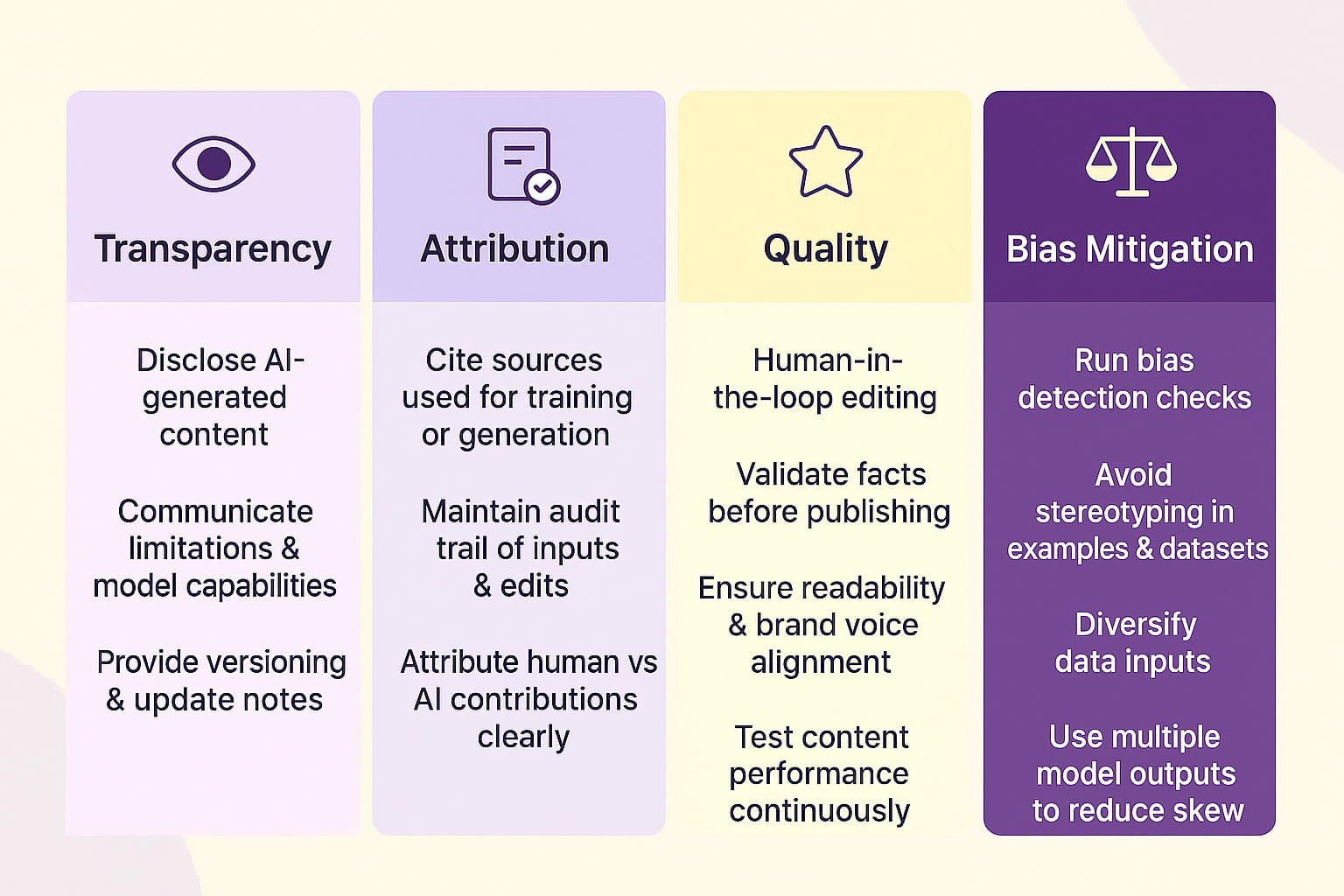
Establish ethical framework: Define acceptable AI use cases (research, drafting acceptable; final decisions, sensitive topics require human judgment). Determine disclosure thresholds (over 30% AI contribution warrants mention). Implement quality gates (expert review mandatory, fact-checking standard, plagiarism checks required).
Attribution matters: Never pass off AI content as entirely original. Add significant human expertise. Cite sources. Transform AI outputs substantially (40%+ original content). Run plagiarism checks. Maintain audit trails.
Build trust through consistency: Prioritize reader value over SEO manipulation. Maintain an authentic voice. Respond honestly to concerns. Demonstrate quality.
Best Practices for AI and Human Collaboration in Content
Collaboration philosophy determines success. AI and humans possess complementary strengths – strategic combination multiplies effectiveness.
AI Strengths vs Human Strengths:
| Task Category | AI Strengths | Human Strengths | Combined Approach |
|---|---|---|---|
| Ideation | Generate 100+ ideas quickly | Strategic filtering, brand understanding | AI generates → Humans curate → Collaborative refinement |
| Research | Process massive information fast | Evaluate credibility, synthesize insights | AI compiles → Humans verify and add expertise |
| Drafting | Fast first drafts, consistent structure | Unique voice, storytelling, emotion | AI creates foundation → Humans add personality |
| Editing | Grammar, readability scores | Context understanding, tone refinement | AI handles technical → Humans ensure alignment |
| SEO | Keyword research, competitive analysis | Search intent, user experience focus | AI provides data → Humans make strategic decisions |
| Visuals | Generate images quickly | Art direction, brand aesthetics | AI creates options → Humans select/refine |
| Distribution | Optimal timing, A/B testing | Community management, authentic engagement | AI optimizes delivery → Humans manage relationships |
| Analysis | Data processing, pattern identification | Strategic interpretation, actionable insights | AI crunches numbers → Humans extract meaning |
Grammar and Style Enhancement with AI
AI grammar tools transform editing efficiency. Grammarly, Hemingway, and HubSpot’s AI assistant catch technical errors while maintaining natural voice.
Effective workflow:
- Generate AI draft.
- Run automated grammar checks (accept obvious corrections, flag questionable suggestions).
- Conduct voice preservation review (read aloud, replace generic phrases, inject personality).
- Verify facts (cross-reference claims, add citations).
- Apply strategic enhancement (strengthen arguments, improve transitions).
- Execute quality control (brand consistency, SEO verification, plagiarism scan).
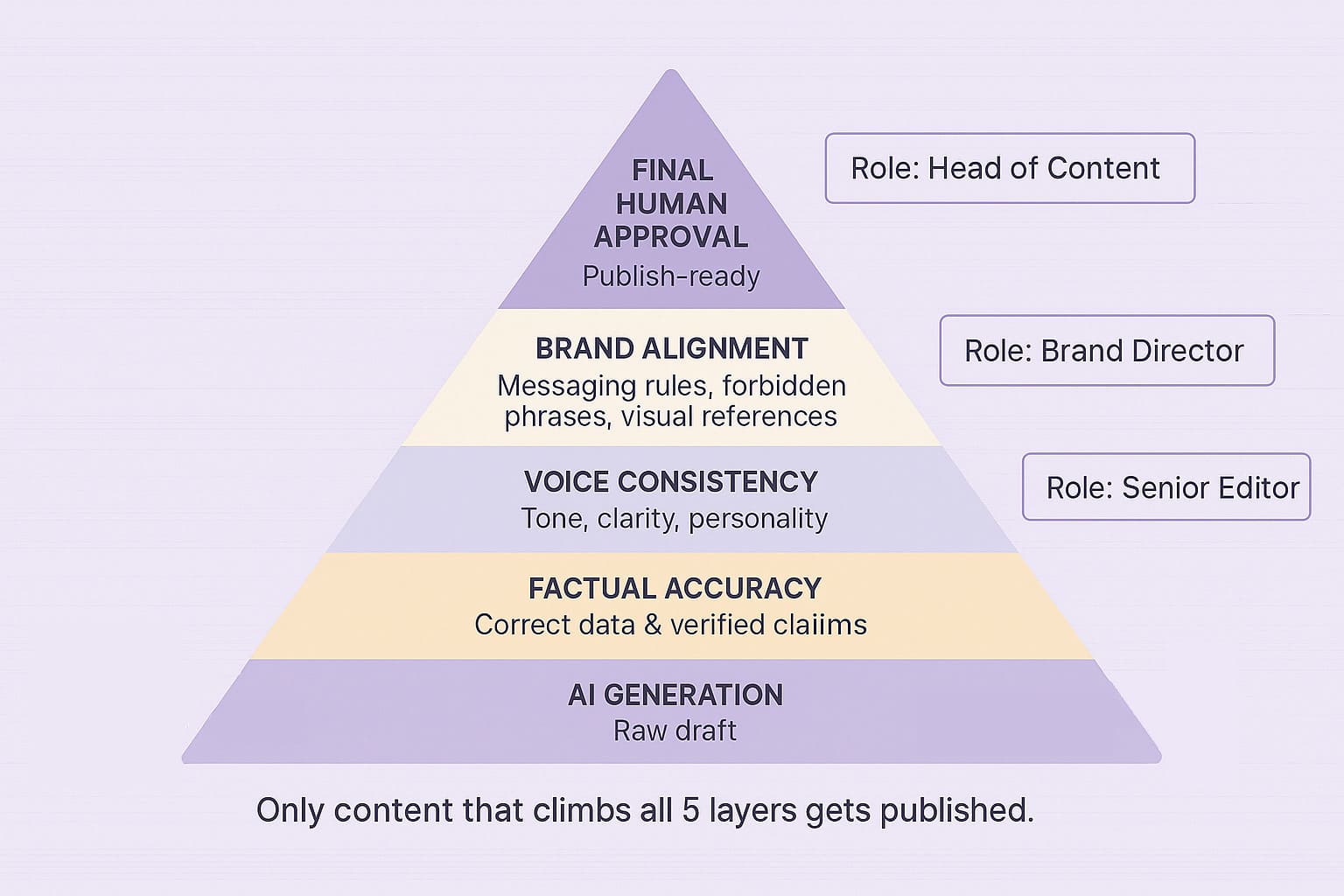
Balance AI efficiency with human judgment. Accept 70-80% of AI grammar suggestions, reject those harming voices. Use readability scores as guides not mandates (aim for 60-70). Maintain an authentic voice.
Reviewing and Enhancing AI-Generated Content
Quality control determines AI content success. Systematic review ensures outputs meet standards.
7-Step AI Content Review Process:
- First Read (5 min): Gut-check quality. Note impression. Identify major issues. Decide if worth continuing.
- Fact-Checking (15-20 min): Cross-reference statistics. Verify proper nouns. Check dates. Validate technical information. Replace incorrect facts.
- Voice Injection (20-30 min): Replace robotic transitions. Add anecdotes. Inject humor, emotion. Use brand language. Read aloud.
- Value Addition (30-45 min): Include proprietary data. Add expert analysis. Provide actionable recommendations. Share lessons learned.
- SEO Optimization (15-20 min): Optimize headings. Add links. Ensure heading hierarchy. Break up paragraphs. Add visual breaks.
- Grammar Polish (10-15 min): Run Grammarly. Check readability (aim 60-70). Eliminate passive voice. Tighten sentences.
- Quality Sign-off (5-10 min): Score against rubric (80+/100 required). Verify checklists. Confirm ethical guidelines. Final plagiarism check.
Quality Rubric: Factual Accuracy (0-20), Brand Voice (0-20), Unique Value (0-20), Engagement (0-15), SEO (0-10), Grammar (0-10), Ethics (0-5). Minimum 80/100 required.
Time Investment: Total review 100-140 minutes. AI draft 30-60 minutes. Combined: 2-3 hours versus 8-10 hours manual (70% savings maintaining quality).
The Future of AI in Content Marketing
Global AI market projections reach $1.8 trillion by 2030. Near-term (2025-2026): multimodal AI generating text, images, video, audio from single prompts (GPT-5, Gemini Ultra), real-time personalization, automated video generation reaching professional quality.
Mid-term (2026-2027): predictive content performance forecasting success before publication, autonomous optimization continuously improving published content, hyper-personalized content at scale.
Skeptical areas: fully autonomous content without oversight (quality concerns), AI replacing strategic thinking (humans still needed), one-size-fits-all solutions (specialization wins).
AI for Content Personalization and Recommendations
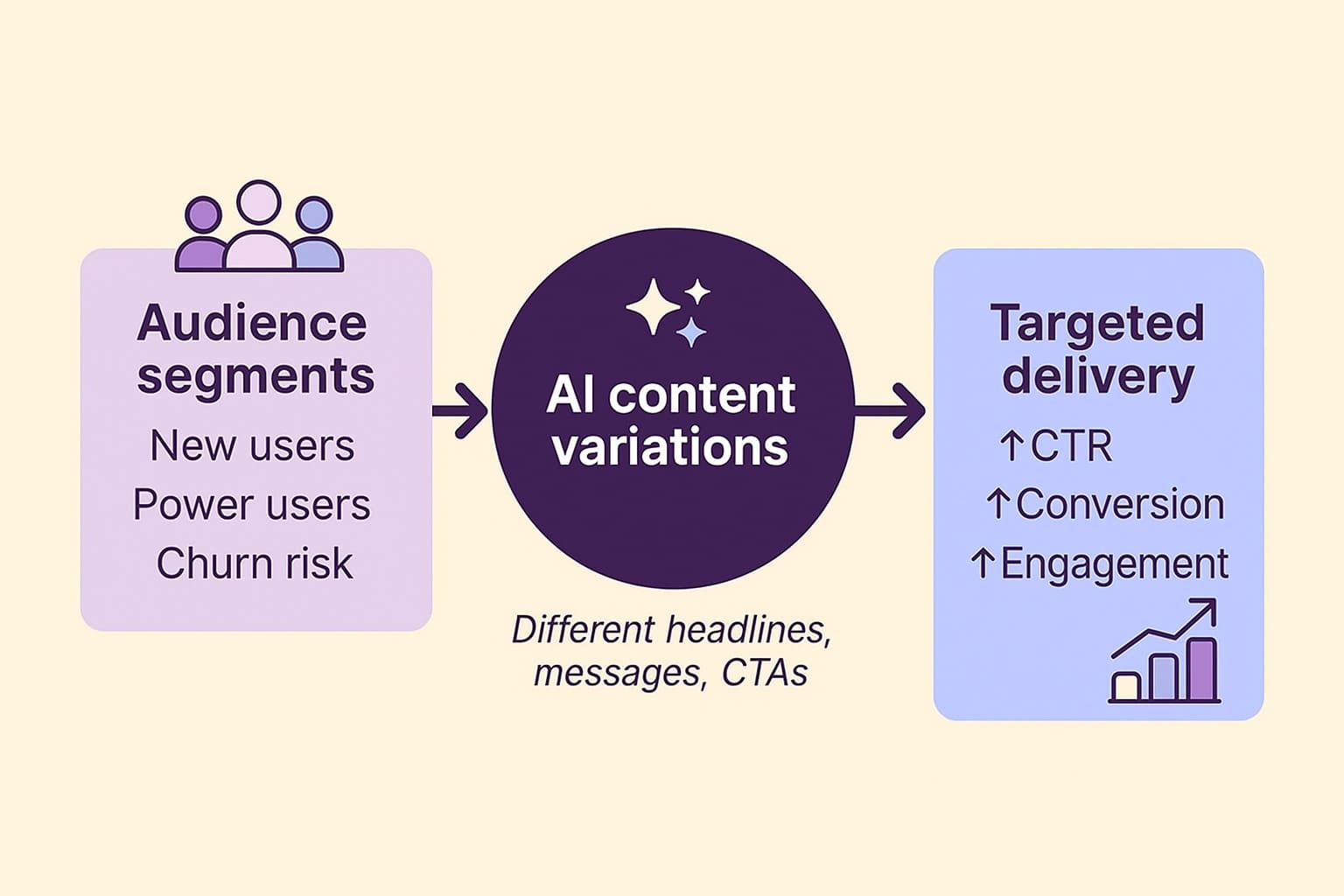
AI enables personalization previously impossible at scale. Modern platforms analyze visitor behavior, engagement patterns, and demographics to deliver uniquely tailored content experiences.
Personalization workflow:
- Data collection (website behavior, email engagement, social interactions, purchase history).
- AI segmentation (cluster users, identify preferences, predict interests).
- Content tailoring (dynamic email subjects, personalized recommendations, customized CTAs, adaptive website content).
- Performance measurement (engagement by segment, conversion lift, continuous optimization).
Implementation requires tools: Segment.io for collection, ChatGPT API for variation generation, HubSpot for delivery, Google Optimize for testing. Results: 45% increase in engagement, 38% reduction in bounce rate, 156% improvement in conversions, 3x ROI within six months.
Privacy considerations: Never use personal data without consent. Implement anonymization. Provide opt-out. Comply with GDPR. Balance personalization with privacy respect.
Preparing Content Teams for an AI-Enhanced Future
Future-proof skills divide into critical human skills AI cannot replicate: strategic thinking (business goals, audience needs), creative problem-solving (unique angles, innovative approaches), emotional intelligence (psychology, cultural nuances), subject matter expertise (deep domain knowledge), ethical judgment (complex decisions).
AI collaboration skills: prompt engineering (effective prompts, iterative refinement), AI tool literacy (capabilities/limitations, tool selection), quality evaluation (distinguishing good output), human-AI workflow design (optimizing processes), AI output enhancement (adding unique value).
Team development: Reframe roles (writers become strategists, editors become quality directors). Invest in training (monthly workshops, prompt engineering sessions). Create psychological safety (transparent communication, celebrate wins, address fears). Reward adaptation (recognize embracing AI, incentivize development). Continuous evolution (quarterly assessments, stay ahead of capabilities, experiment with tools).
Result: Teams transform from resistant to embracing AI within 12 months through consistent support and training.
Getting Started: AI Content Creation Roadmap
Implementation spans 90 days.
Phase 1 (Days 1-30) focuses on learning: audit workflows identifying bottlenecks, set measurable goals, allocate $200-500 monthly budget, start with free tools (ChatGPT, Grammarly), test 3-5 tools, select 1-2 to invest in ($20-100/month).
Phase 2 (Days 31-60) emphasizes implementation: introduce AI at one stage first (drafting), document processes, train teams through 2-hour workshops, create prompt libraries, establish quality checkpoints, gather feedback, add AI to second stage.
Phase 3 (Days 61-90) scales and measures: implement AI touchpoints at every stage, automate repetitive tasks through APIs and Zapier, expand to new formats, refine quality control, conduct ROI analysis, identify what’s working, set next goals.
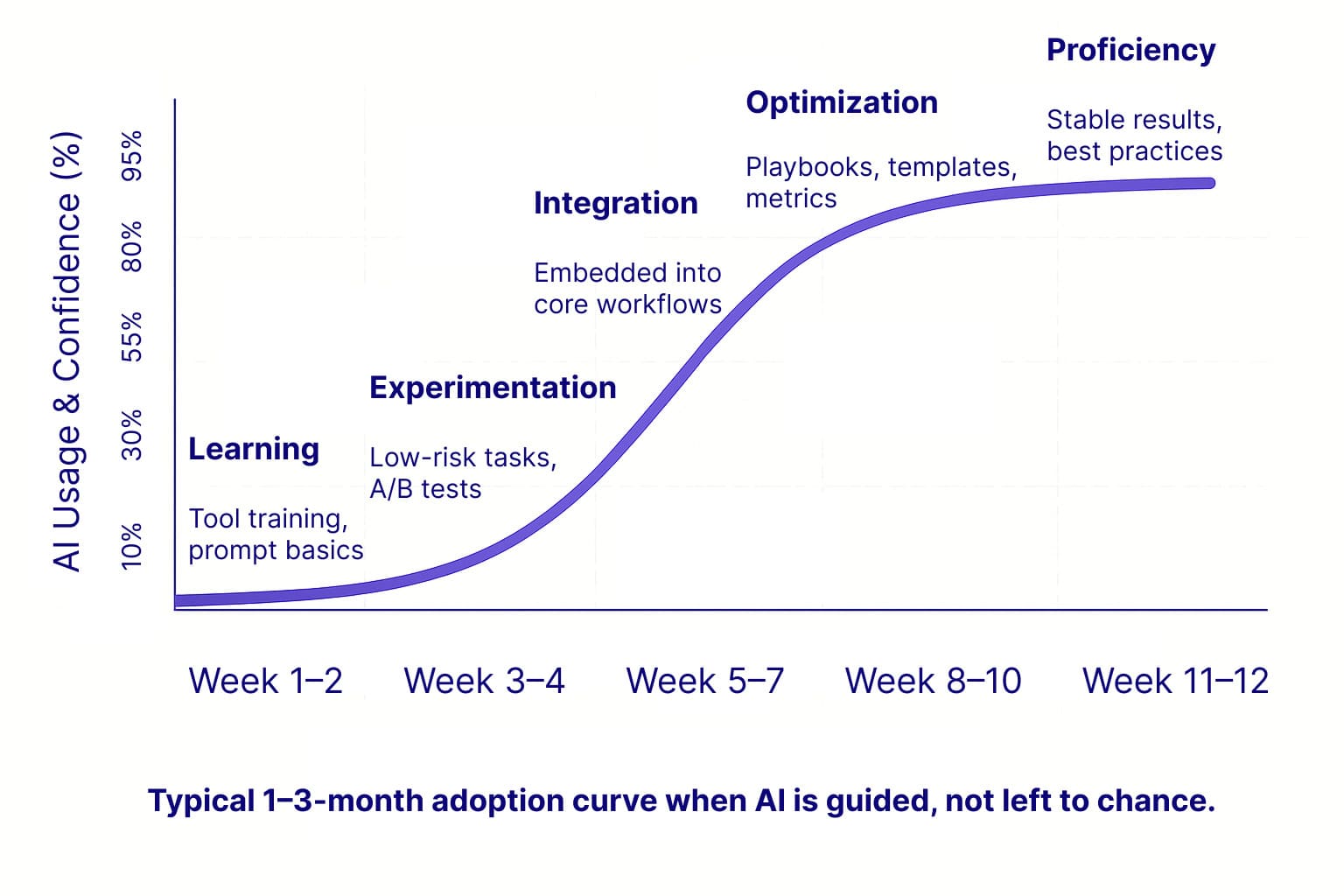
Success criteria:
✅ 40%+ reduction in production time.
✅ Maintained or improved quality.
✅ 80%+ team comfortable.
✅ Positive ROI.
✅ Documented workflows.
Recommended AI Tools and Resources
Tool selection depends on needs and budget.
For text: ChatGPT Plus ($20/month) for long-form with GPT-4, Claude Pro ($20/month) for complex analysis, Jasper ($49-125/month) for brand voice, Grammarly Business ($15/user/month) for real-time editing.
For SEO: Surfer SEO ($89-219/month) for content editor, Semrush ($129-499/month) for all-in-one platform. For visuals: DALL-E 3 (via ChatGPT Plus) for blog images, Canva AI ($12.99/month) for social graphics.
For video: Descript ($12-24/month) for text-based editing, Pictory ($19-99/month) for text-to-video. For audio: ElevenLabs ($5-330/month) for voice cloning across 29 languages.
Learning resources: OpenAI Cookbook (prompt engineering examples), Anthropic Claude documentation (LLM capabilities), YouTube: AI Explained, Matt Wolfe (staying current).
Full disclosure: No affiliate relationships. Recommendations based solely on testing. Pricing current as of 2025 but subject to change.
Conclusion: Embracing the AI-Content Revolution
The AI content revolution isn’t about humans versus machines – it’s about humans empowered by machines. The 60-70% time savings don’t replace human creativity; they amplify it. AI handles the mechanical, freeing humans for what matters: strategic thinking, unique perspectives, authentic storytelling, and emotional connections algorithms can’t replicate.
Expertise, judgment, and voice remain irreplaceable – AI simply helps share them at scale. Start small, experiment boldly, maintain ethical standards. The best content creators master collaboration between human creativity and artificial intelligence.
The future belongs to content strategists who embrace AI as a powerful assistant while doubling down on uniquely human elements that make content resonate, persuade, and inspire.
Frequently Asked Questions
What is AI content creation?
AI content creation uses generative AI models like GPT-4 and Claude to produce text, images, video, and audio content from prompts. These tools leverage machine learning trained on vast datasets to generate human-like content, requiring 60-70% less time than manual creation while needing human oversight for quality, accuracy, and brand voice consistency.
How does AI content creation work?
AI content tools use large language models trained on billions of text examples from books, websites, and articles. When provided with a prompt, the AI predicts the most likely next words based on patterns learned during training, generating coherent content across 50+ languages with customizable style, tone, and format.
Which AI is good for content creation?
Best tools vary by need: ChatGPT and Claude for long-form drafts and research, Jasper for marketing copy with brand voice, Grammarly for editing, Surfer SEO for optimization, DALL-E and Midjourney for images, Descript for video and audio editing, ElevenLabs for voice synthesis. Most creators use 3-5 tools in combination.
What are the benefits and limitations of AI in content creation?
Benefits include 60-70% faster drafting, scalable multi-format content, consistent SEO optimization, and 24/7 availability. Limitations include factual errors (hallucinations), generic voice without human enhancement, bias from training data, inability to provide unique expertise, and high human oversight requirements for quality and accuracy.
How can content creators maintain their brand voice when using AI tools?
Create detailed brand voice guides with examples, train AI with 20+ existing content pieces, develop custom prompts including voice instructions, inject personal anecdotes and unique perspectives during editing, review all outputs against voice standards, and use tools like Grammarly’s tone detector to ensure consistency.
What kind of content can AI create?
AI creates blog posts, social media content, email marketing, product descriptions, video scripts, podcast outlines, voiceovers, images, graphics, technical documentation, white papers, case studies, ad copy, and meta descriptions. Effectiveness varies: social posts are nearly publish-ready while complex technical content needs significant human enhancement.
Is AI taking over content creation?
AI augments rather than replaces content creators. While 71.7% of content marketers use AI for outlining, the technology requires human oversight for strategic thinking, brand voice, accuracy verification, and ethical considerations. The best results come from human-AI collaboration, not AI alone.
Can I legally publish content written by AI?
Yes, but with considerations. AI-generated content is legally publishable, though disclosure requirements are increasing. California’s SB 942 (effective January 2026) requires AI content disclosure. Many platforms require labeling AI-generated content. Add significant human transformation and maintain human accountability.
What are the best practices for using AI in content creation?
Establish quality control checkpoints at multiple stages, maintain human oversight for brand voice and accuracy, create detailed brand voice guidelines, implement systematic fact-checking processes, document ethical guidelines and disclosure practices, train teams on effective prompting techniques, start with one workflow stage before scaling.
How is AI changing the traditional content creation workflow?
AI integration reduces content production time by 55% on average while maintaining quality. Teams shift from production focus to strategic enhancement, with AI handling research compilation, initial drafting, grammar correction, and SEO optimization. Human roles evolve to strategists, editors, and quality directors who amplify AI capabilities with expertise and authenticity.</parameter>
 Share
Share
 X
X
 LinkedIn