






 518
518 


A potential customer lands on your website at 10:47 PM, credit card in hand. They’re ready to buy — but first, they need that one case study, the technical specs, something to justify the purchase to their boss tomorrow morning. Three clicks later, they’re lost in a labyrinth of outdated blog posts and mislabeled categories. The content exists somewhere. They just can’t find it.
They leave. Another conversion lost to chaos.
Here’s the uncomfortable truth: nearly 80% of online shoppers choose not to buy products due to poor quality or lack of product content, according to 1WorldSync’s 2024 Consumer Product Content Benchmark Report. Meanwhile, e-commerce brands lose $18 billion annually to cart abandonment — with poor user experience consistently ranking among the top causes.

Content architecture is the systematic approach to organizing, structuring, and managing digital content across multiple channels and touchpoints. It encompasses information architecture, content modeling, workflow design, and technical implementation to create scalable, user-centered content experiences that support business objectives while enabling efficient content management and distribution.
Think of it as the blueprint for your entire digital content ecosystem — one that determines whether visitors find what they need or bounce to your competitors.
Understanding Content Architecture Fundamentals
Content architecture isn’t just about organizing web pages. It’s about building a comprehensive framework that governs how content is created, stored, managed, and delivered across every digital touchpoint your audience encounters.

At its core, content architecture addresses three fundamental challenges:
- Structure: How content is organized hierarchically and relationally across your digital properties
- Scalability: How your content system grows without becoming unmanageable or inconsistent
- User-centricity: How content meets users where they are in their journey
Unlike a simple site map or navigation menu, content architecture operates at a deeper level. It defines content models that determine how different content types (articles, products, FAQs, case studies) relate to each other. It establishes taxonomies and metadata schemas that make content discoverable. And it creates workflows that ensure content moves efficiently from creation to publication to retirement.
Modern content architecture has evolved significantly to accommodate AI-powered workflows, enterprise taxonomy management, and composable technology stacks that adapt to changing business needs. Organizations using well-structured content architecture report significant improvements in content discovery time, asset reuse across teams, and overall operational efficiency.
The practical impact? When content architecture works, users intuitively find what they need. When it doesn’t, even the best content becomes invisible.
Content Architecture vs Information Architecture
These terms often get confused, but they serve distinct purposes:
Information architecture (IA) focuses primarily on the frontend — how information is presented and navigated by users. It answers questions like: How should the navigation be structured? Where do users expect to find specific information? How do labels and categories guide user behavior?
Content architecture encompasses both frontend and backend considerations. It determines:
How content is stored and tagged in your CMS
- Relationships between content pieces (a blog post linked to related resources, products connected to specifications)
- Metadata for categorization, including keywords and publication dates
- Workflows for creating, approving, and publishing content
Here’s a practical distinction: Information architecture might determine that your blog categories should be “Marketing,” “Tech Insights,” and “Case Studies.” Content architecture ensures that each blog post within those categories has consistent metadata, proper internal linking, and a content model that makes repurposing across channels seamless.
The most effective digital experiences integrate both disciplines. IA ensures users navigate intuitively; content architecture ensures the underlying system supports that experience at scale.
| Attribute | Content Architecture | Information Architecture |
|---|---|---|
| Primary Focus | Organizing and managing content across multiple digital touchpoints and channels. | Organizing and presenting information on the frontend to guide user navigation. |
| Scope | End-to-end content organization, from creation to delivery and management. | Primarily focuses on the structure of content and navigation on the user interface (UI). |
| Key Components | Content models, taxonomies, metadata, workflows, content reusability, and modularity. | Site structure, navigation menus, search functionality, and labeling. |
| Content Management | Defines content creation, storage, metadata tagging, internal linking, and workflows. | Focuses on how information is labeled, categorized, and navigated for optimal usability. |
| Backend vs Frontend | Primarily backend: how content is structured, stored, tagged, and managed. | Frontend: how information is displayed, navigated, and used by the audience. |
| User-Centricity | Ensures content meets user needs at different touchpoints in their journey. | Aims to guide users to find and use information efficiently on the website. |
| Scalability | Ensures systems can grow and scale while maintaining consistency and performance. | Focuses on navigation and user flow, but doesn't address backend scalability issues directly. |
| Content Type Structure | Defines specific content models for different types (e.g., blog posts, product pages). | Defines |
Core Components of Content Architecture
Building effective content architecture requires several interconnected components working together. Each element serves a specific purpose in creating a system that’s both user-friendly and operationally efficient.
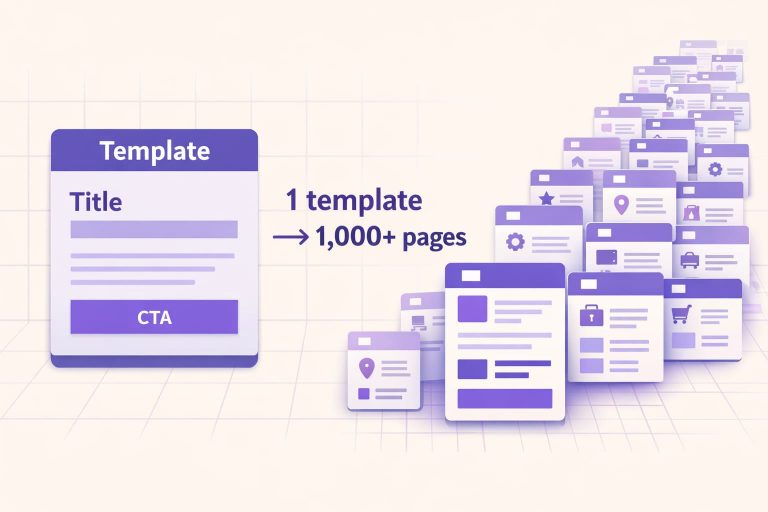
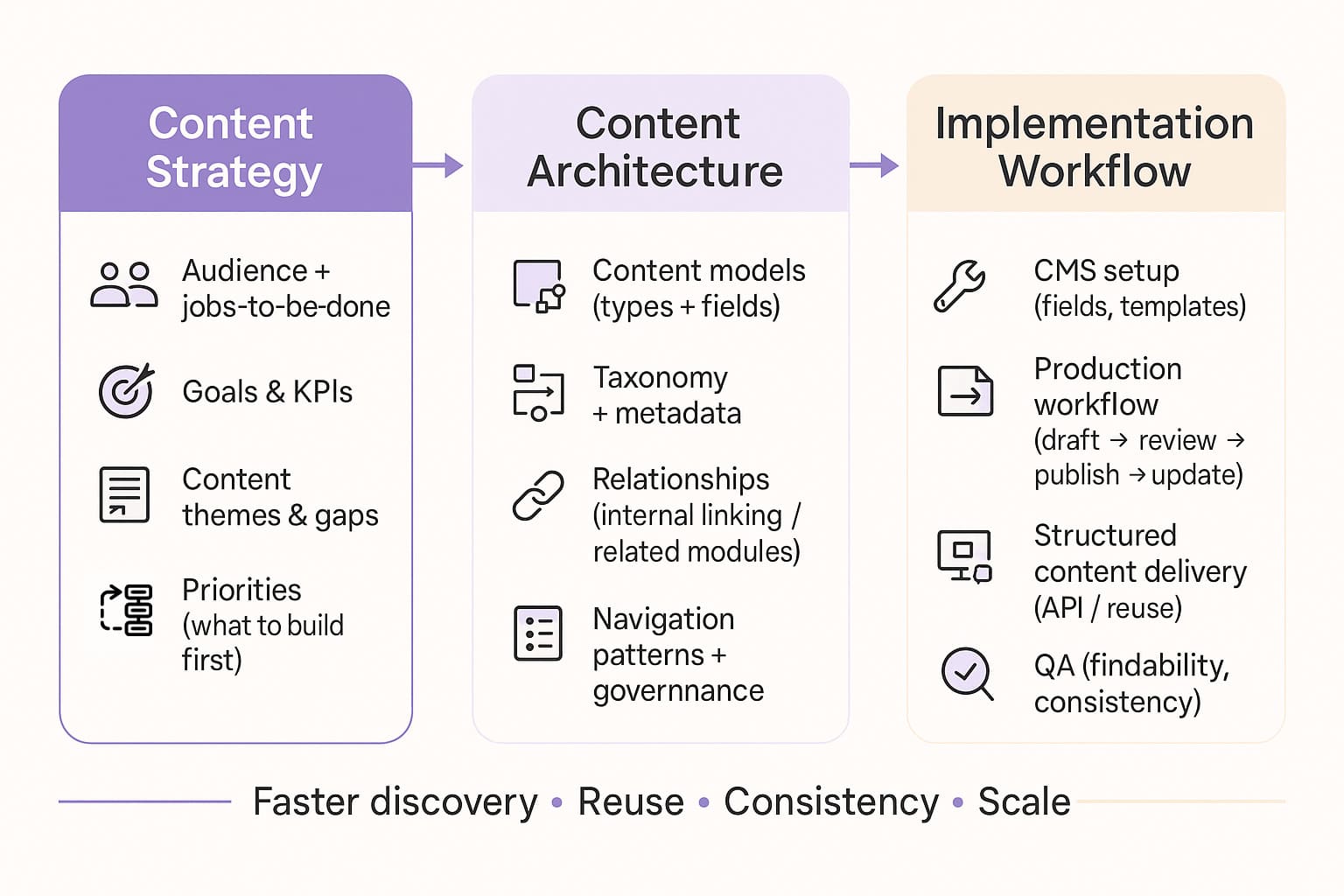
Content Models define the structure of different content types. A blog post might include fields for title, author, published date, categories, featured image, and body content. A product page requires different fields: SKU, pricing, specifications, related products, and availability. Clear content models ensure consistency across thousands of content pieces and make content easier to manage, query, and present.
Taxonomy and Metadata organize content into discoverable categories. Metadata provides descriptive tags (keywords, dates, content types), while taxonomy creates hierarchical relationships. For example:
Metadata: “Content Strategy, SEO, Enterprise” Taxonomy: “Digital Marketing > Content Strategy > Enterprise Solutions”
This structured approach enables both users and systems to locate relevant content instantly — critical for sites with hundreds or thousands of pages.
Navigation Systems determine how users move between content. This includes primary navigation, breadcrumbs, related content modules, and internal linking strategies. Effective navigation balances simplicity with comprehensiveness.
Workflow Management defines who creates content, who approves it, and how it moves from draft to publication. For enterprise organizations with multiple stakeholders — content creators, marketing managers, compliance reviewers, legal teams — robust workflows prevent bottlenecks and maintain content integrity.
Content Modeling and Wireframing
Content modeling starts with auditing existing content and identifying patterns. What types of content do you create repeatedly? What fields does each type require? Where does content get reused?
A practical content modeling process:
- Inventory all content types across your digital properties
- Identify common attributes and unique requirements for each type
- Define relationships between content types (products → specifications → reviews)
- Create templates that enforce consistency while allowing flexibility
- Document the model so all stakeholders understand the structure
Content wireframes visualize how content assets relate to each other before design begins. Unlike design wireframes that focus on visual layout, content wireframes map the content hierarchy, showing which elements appear on a page, their relative importance, and how they connect to other content.
At Lead Craft, we’ve found that content wireframing dramatically reduces revision cycles. When teams align on content structure before design starts, they avoid costly redesigns later.
Structured Content Implementation
Structured content treats content as modular, reusable data rather than page-specific copy. Instead of creating a product description that lives only on one page, structured content creates a description component that can be pulled into product pages, comparison charts, email campaigns, and mobile apps.
Benefits of structured content:
- Reusability: Create once, publish everywhere
- Consistency: Updates propagate across all instances automatically
- API compatibility: Content can be delivered to any platform via APIs
- Future-proofing: New channels can access existing content without recreation
Implementing structured content typically requires a headless CMS or similar API-first platform. These systems store content independently from presentation, enabling the same content to feed websites, mobile apps, digital displays, and even voice interfaces.
The Role of Content Architects and Teams
Content architects bridge the gap between business strategy, user experience, and technical implementation. They’re the professionals who translate organizational goals into content structures that actually work.
Core responsibilities of a content architect:
- Conducting content audits to assess current state
- Designing content models, taxonomies, and metadata schemas
- Creating governance frameworks and style guides
- Collaborating with UX designers on navigation and user flows
- Working with developers on CMS configuration and API design
- Training content teams on new structures and workflows
Content architects typically work alongside UX designers (who focus on user interaction patterns), content strategists (who define what content gets created and why), and developers (who implement technical infrastructure).
Career path and compensation: According to Glassdoor data, content architects in the United States earn median total compensation of approximately $128,000 annually, with salaries ranging from roughly $99,000 to $169,000 depending on experience, location, and industry. Senior content architects at enterprise organizations often command higher compensation, particularly those with technical skills in headless CMS platforms, API design, and content automation.
For professionals interested in becoming content architects, the path typically involves experience in content strategy, information architecture, or UX design, combined with technical understanding of content management systems and structured data principles.
Business Benefits and Strategic Impact
“Research shows that, on average, around 70% of online shoppers abandon their carts, with poor user experience being one of the key factors contributing to cart abandonment.”
Content architecture isn’t just an operational improvement — it’s a revenue driver. Organizations with well-designed content systems consistently outperform those managing content chaos.
Quantifiable benefits:
Improved User Experience: When users find content quickly and intuitively, engagement increases. Poor content organization contributes to the approximately 70% cart abandonment rate that plagues e-commerce, with confusing site navigation cited as a significant factor.
Reduced Content Operations Costs: Structured content eliminates redundant creation. Instead of writing the same product description for five different channels, teams create it once and distribute it everywhere. For enterprise organizations managing thousands of content assets, this efficiency compounds dramatically.
Faster Time-to-Market: With clear content models and workflows, new content moves from concept to publication faster. Teams spend less time figuring out where content belongs and more time creating valuable material.
Scalability: Good architecture grows with your business. Adding new product lines, entering new markets, or launching new channels becomes manageable rather than chaotic.
Consistency and Brand Integrity: When content structure enforces brand standards, inconsistencies decrease. Every piece of content adheres to the same quality standards regardless of who created it.
Better Personalization: Structured content with robust metadata enables sophisticated personalization. You can serve different content to different audiences because your system knows what content exists and how it’s categorized.
Implementation Strategies and Best Practices
Implementing content architecture requires balancing immediate needs with long-term scalability. The following strategies help organizations build frameworks that grow with their content operations.
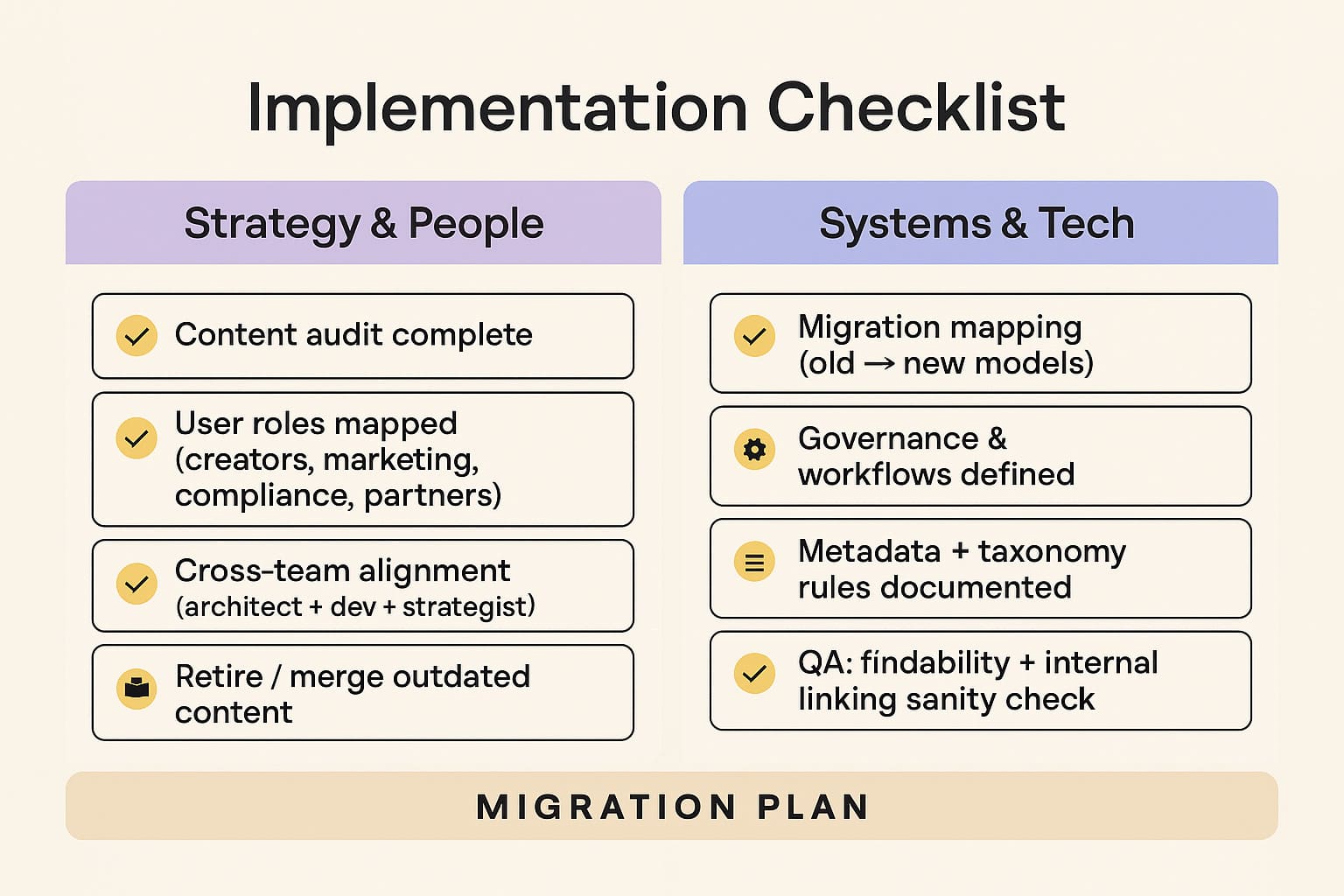
Start with a comprehensive content audit: Before designing new architecture, understand what you have. Catalog all content types, identify current pain points, and document how different stakeholders interact with content throughout creation and deployment processes.
Design for multiple user types: Effective architecture accommodates diverse needs — content creators, marketing managers, compliance reviewers, external partners. Role-based access controls and customized interfaces ensure each user type can access relevant functionality without unnecessary complexity.
Prioritize collaboration across teams: Content architects, developers, and strategists need shared understanding of goals, brand messaging, and technical constraints. Misalignment between these groups is one of the most common causes of content architecture failure.
Plan for migration: If you’re moving from an existing system, content migration deserves careful planning. Map old content structures to new models, identify content that should be retired, and allocate realistic timelines for the transition.
Choosing the Right Technology Stack
Technology selection significantly impacts content architecture success. The right platform makes good architecture easy to maintain; the wrong one creates constant friction.
Key evaluation criteria:
| Factor | Traditional CMS | Headless CMS |
|---|---|---|
| Content-Presentation Coupling | Tightly coupled | Decoupled |
| Multi-channel Distribution | Limited | Native support |
| Developer Flexibility | Constrained by templates | Full control over frontend |
| Content Reusability | Page-specific | Modular and reusable |
| API Capabilities | Often limited | API-first architecture |
| Learning Curve | Generally lower | Requires technical resources |
Headless CMS platforms (Contentful, Hygraph, Strapi, and others) have become the standard for organizations requiring omnichannel content distribution. By separating content storage from presentation, headless systems enable true content reusability and future-proof your architecture against new channels and technologies.
However, headless isn’t automatically the right choice. Organizations with simpler needs—a single website without complex multi-channel requirements—may find traditional CMS platforms more practical and cost-effective.
The decision should factor in:
- Current and anticipated channel requirements
- Technical team capabilities
- Integration needs with existing marketing and development tools
- Budget for implementation and ongoing maintenance
Advanced Content Architecture Strategies
As content architecture matures, organizations can implement sophisticated strategies that drive competitive advantage.
Personalization frameworks leverage structured content and robust metadata to deliver tailored experiences. When content is properly tagged with audience attributes, behavior triggers, and contextual relevance, systems can dynamically assemble personalized pages without manual intervention.
Omnichannel distribution requires content that adapts to different contexts. A product description optimized for desktop might need different formatting for mobile, different length for social media, and different tone for email. Structured content with channel-specific variants enables this flexibility without content duplication.
Content federation addresses enterprise-scale challenges where content originates from multiple systems—product information from PIM systems, marketing content from the CMS, regulatory content from compliance systems. Federated content architecture creates unified access to distributed content sources.
AI-search optimization represents an emerging frontier. As consumers increasingly discover content through AI-powered search tools like ChatGPT, Google’s AI Overviews, and Perplexity, content architecture must accommodate these new discovery patterns. This means structuring content with clear semantic relationships, implementing comprehensive schema markup, and organizing information in ways that AI systems can easily parse and cite.
For organizations seeking to optimize their content for AI-powered search visibility, Lead Craft’s Generative Engine Optimization service applies content architecture principles specifically for AI citation mechanisms. This approach has helped clients achieve 27-40% increases in qualified leads by ensuring their structured content appears in AI-generated responses across platforms.
Conclusion
Content architecture transforms how organizations create, manage, and deliver digital experiences. When implemented effectively, it reduces operational friction, improves user experience, and creates scalable systems that grow with your business.
Priority recommendations for getting started:
- Audit your current content ecosystem to identify structural gaps
- Define content models for your most critical content types
- Evaluate whether your current CMS supports your architecture needs
- Establish governance frameworks before scaling content production
The organizations winning in digital aren’t just creating more content — they’re creating better systems for managing it. Content architecture is that system.
FAQs
What are the 3 C’s of content strategy?
The 3 C’s — Content, Context, and Communication — form the strategic framework guiding content architecture decisions. Content addresses what you create, Context determines where and when it appears, and Communication defines how it reaches and resonates with audiences.
What are the 4 C’s of content marketing?
Create, Curate, Connect, and Convert represent the content marketing framework that content architecture supports. Architecture ensures created content is organized for curation, connected across channels, and structured to drive conversions.
What is the 70 20 10 rule in content marketing?
This distribution guideline suggests allocating 70% of content to proven formats that engage your audience, 20% to innovative content that tests new approaches, and 10% to experimental content. Effective content architecture supports all three categories through flexible content models.
What is the 80/20 rule in social media marketing?
The 80/20 rule recommends that 80% of social content should provide value to audiences (education, entertainment, inspiration) while only 20% directly promotes products or services. Content architecture enables this balance through proper tagging and content type classification.
What is the 60 30 10 rule in UX design?
This visual hierarchy principle allocates 60% to a dominant color, 30% to a secondary color, and 10% to accent colors. In content architecture, similar hierarchy principles apply—ensuring primary content receives prominence while supporting content remains accessible but not distracting.
What is the 80 20 rule in UX design?
The Pareto principle applied to UX suggests that 80% of user engagement comes from 20% of features or content. Content architecture uses this principle to prioritize high-impact content placement and structure navigation around the most-used pathways.
How much do content designers get paid?
Content designers in the United States typically earn between $65,000 and $120,000 annually, with content architects commanding premium compensation for strategic expertise. Factors including location, industry, and technical skill depth significantly influence compensation ranges.
What are the three main types of architecture?
In digital content contexts, Information Architecure (frontend user navigation), Content Architecture (end-to-end content organization), and Technical Architecture (infrastructure and systems) work together to create comprehensive content experiences.
 Share
Share
 X
X
 LinkedIn