



 493
493 


Most businesses spend months creating 50 blog posts. Meanwhile, companies like Zapier generate 50,000+ pages in weeks – and see traffic soar from 1.2 million to 4.8 million monthly visits in just three years. The difference? A programmatic SEO strategy that automates what you’re still doing manually. And in 2025, with 73% of SEO professionals integrating AI tools into their strategies, the gap between automated and manual approaches has never been wider.
What is Programmatic SEO?
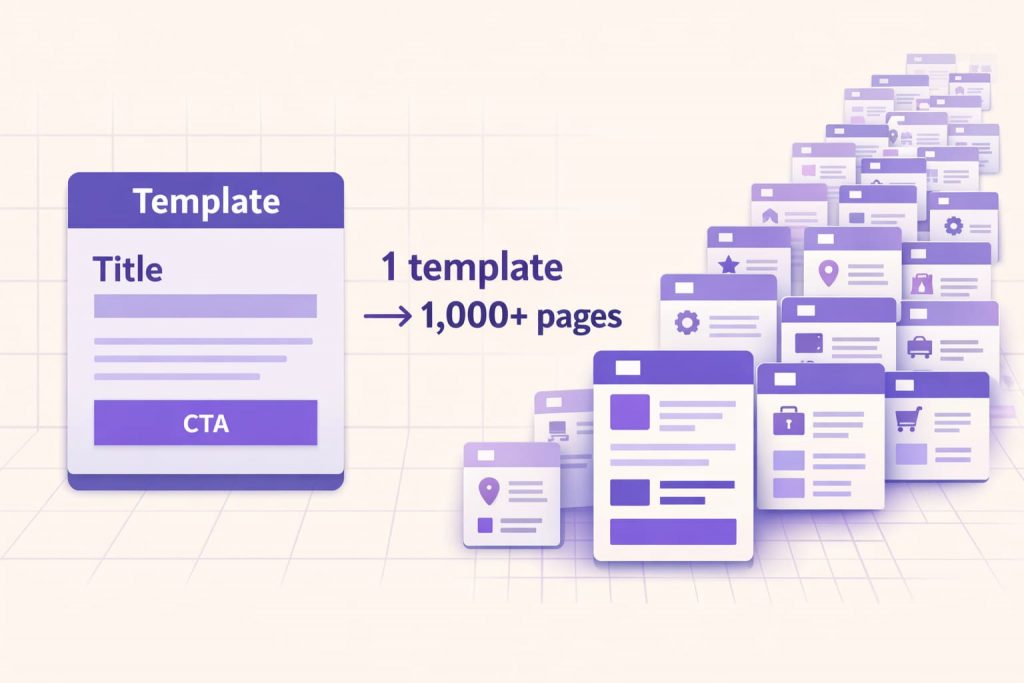
Programmatic SEO is the automated approach to creating hundreds or thousands of SEO-optimized pages at scale by combining data-driven templates with structured datasets. Instead of writing each page from scratch, you build a reusable template once, then populate it with unique data from databases, APIs, or spreadsheets to generate programmatic content that matches specific search intents.
Think of it like this: traditional SEO is handcrafting furniture – each piece takes hours of skilled labor. Programmatic SEO is the assembly line – you design the blueprint once, then manufacture thousands of variations efficiently. The systematic approach leverages a data-driven content strategy combined with SEO templates to create scalable content targeting long-tail keywords competitors miss.
This template-based SEO strategy enables businesses to target long-tail keyword opportunities efficiently, generating programmatic content in minutes rather than weeks. A single template can spawn 1,000+ optimized pages in days versus months of manual work.
How Does Programmatic SEO Work?
At its core, programmatic SEO operates through three interconnected components: SEO templates, structured data, and SEO automation. The template serves as your page blueprint with dynamic field placeholders. Structured data from databases or APIs populates these placeholders with unique information for each target keyword. Automation connects the two, deploying programmatic content at scale through your CMS platform.
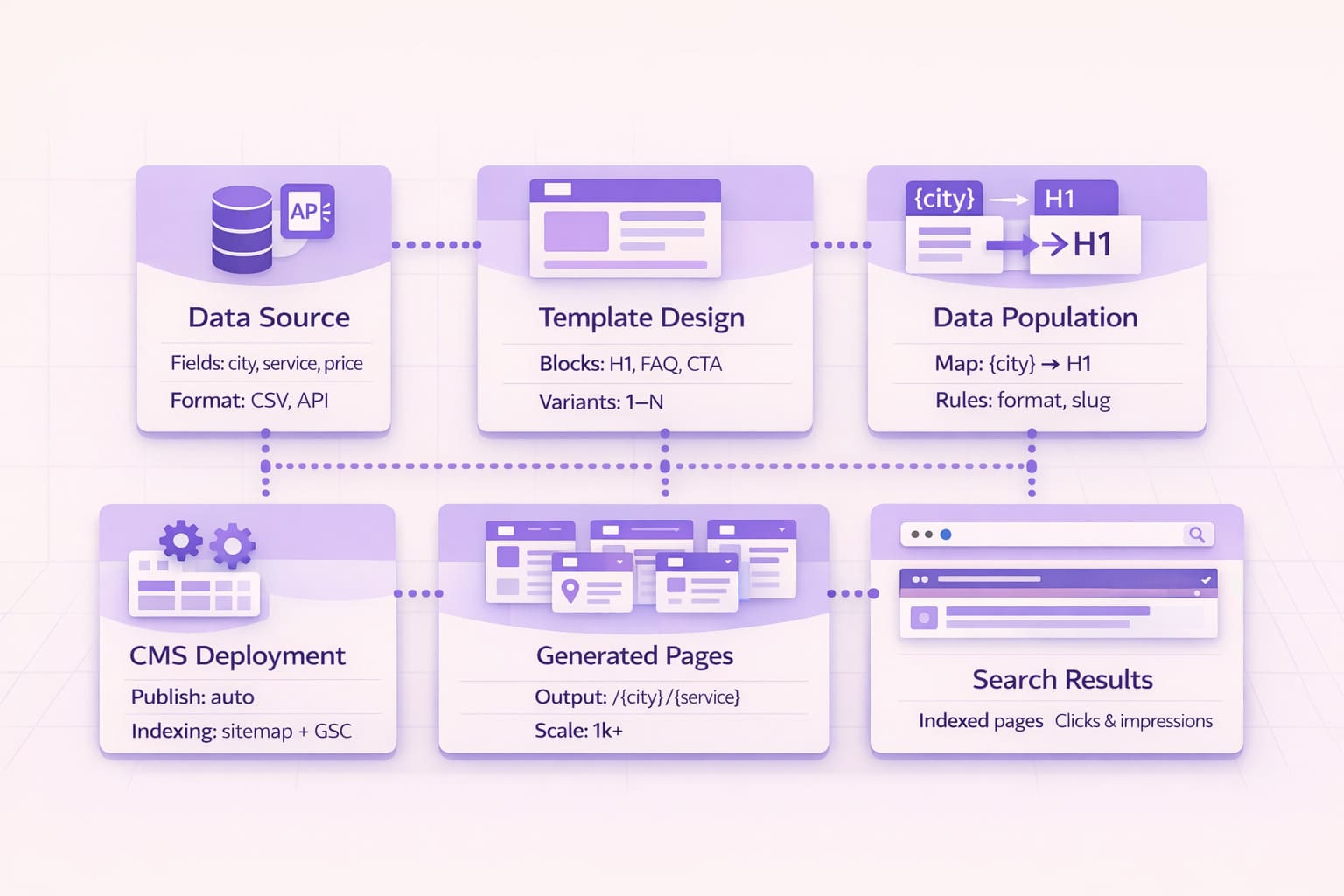
Here’s the six-step workflow that powered our 400% traffic increase:
- Keyword Research to Identify Scalable Opportunities. Find patterns where one head term combines with multiple modifiers. For example, “software integration” (head term) + location, app name, or use case (modifiers) generates thousands of keyword variations like “Slack Gmail integration” or “CRM automation tools.”
- Data Collection from Multiple Sources. Aggregate information from APIs, scrape public databases, or manually curate datasets. The key is ensuring data quality – every field must be accurate, complete, and provide genuine value.
- Template Design with Dynamic Field Placeholders. Create one page structure that works for all variations. Include dynamic fields for title, description, key features, pricing, and unique differentiators. The template must be flexible enough to accommodate data variations while maintaining consistent quality.
- CMS Configuration with Custom Fields. WordPress approach: Use Advanced Custom Fields Pro to create custom post types with 15-20 fields for dynamic content. WP All Import ($99-299) handles automated content generation and bulk data population – essential programmatic SEO tools for WordPress implementations.
- Webflow approach: Build CMS collections with dynamic fields, then use Whalesync to sync data from Airtable or Google Sheets. Webflow’s CMS API enables programmatic page creation at scale – key programmatic SEO tools for visual builders.
- Automated Data Population via Scripts or Plugins. Connect your database to the template. For WordPress, import CSV files through WP All Import. For Webflow, set up two-way sync with Whalesync to automatically create pages when new data rows are added.
- Deployment and Indexation Monitoring. Publish pages strategically – Google handles large batches better when you submit updated sitemaps and verify indexation through Search Console. Monitor crawl rates and adjust publishing velocity accordingly.
Data Quality Framework: 5 Essential Validation Checks
Before populating SEO templates with data, validate every field through these critical checks:
- Accuracy Verification: Cross-reference data against original sources, ensuring statistics, dates, and specifications are current and correct.
- Completeness Assessment: Confirm all required fields contain meaningful information, not placeholders or null values that create thin content.
- Uniqueness Evaluation: Verify each data combination differentiates the page from others, avoiding duplicate or near-duplicate programmatic content.
- Value Analysis: Assess whether information genuinely helps users make decisions or answers specific questions beyond generic descriptions.
- Formatting Consistency: Standardize data presentation across all pages – consistent units, date formats, and terminology maintain professional quality.
The Benefits of Programmatic SEO
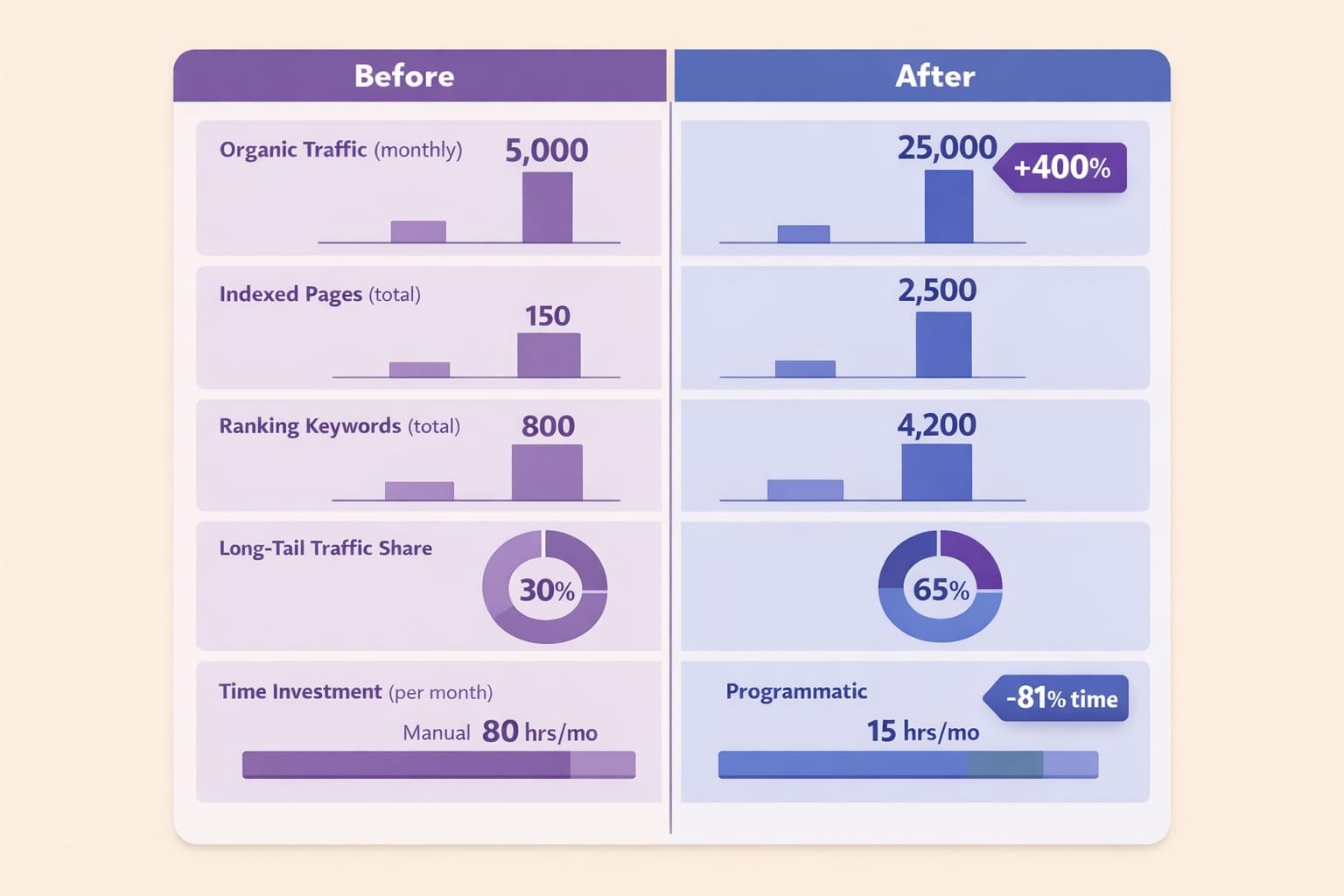
Scalability is the most compelling advantage. Generate 1,000+ pages in hours versus months of manual work. A client we worked with scaled from 150 to 2,500 indexed pages in 6 months, systematically covering entire keyword clusters that competitors ignored with their programmatic SEO strategy.
Efficiency optimization follows naturally. Programmatic SEO delivers 80-90% reduction in time per page, reallocating resources from repetitive creation to strategic optimization and analysis. Lower cost per page at scale means better ROI – especially when you consider the average SEO campaign returns $7.48 for every dollar spent.
Long-tail keywords are the traffic growth mechanism. Target specific search intents with precision, capturing visitors competitors miss with their manual approaches. These keywords typically face lower competition and deliver higher conversion rates. In our implementation, 65% of traffic came from long-tail variations that each drove 20-100 monthly visits – small individually, massive collectively.
Competitive advantage emerges from comprehensive coverage. First-mover advantage in niche keyword spaces creates authority signals search engines recognize. Once you’ve claimed territory with thousands of indexed pages, competitors face an uphill battle replicating manually what took you weeks to automate.
The strategic outcome? A programmatic SEO strategy that doesn’t just rank for more keywords – it builds a moat that’s difficult to breach without similar automation capabilities.
Programmatic SEO Examples That Actually Work
Real-world implementations reveal what separates successful programmatic SEO from thin content spam. These companies didn’t just generate programmatic content – they created genuine value at scale, combining automated content generation with strategic thinking that search engines reward.
Let’s examine three implementations that demonstrate different approaches to programmatic SEO, each addressing unique challenges while following similar underlying principles.
Zapier's App Directory Strategy
Zapier exemplifies SaaS programmatic SEO at its finest. Their 50,000+ integration pages each target specific integration keywords like “Connect Slack to Gmail” or “Salesforce HubSpot integration.” Each page serves a clear search intent while providing actionable value.
The API-powered approach generates dynamic, data-rich pages pulling real-time integration capability data, use case examples from user submissions, and pricing information with feature comparisons. This isn’t static content – it’s living documentation that updates as their platform evolves.
Internal linking strategy distinguishes Zapier’s implementation. A hub-and-spoke structure connects related integrations, with category pages organizing integrations by app type and contextual links between complementary tools. This architecture helps both users and search engines discover relevant content efficiently.
What makes these pages valuable rather than spammy?
- Automated “Zap” templates users can implement immediately with one click.
- User reviews and ratings providing social proof and fresh content.
- Step-by-step setup instructions unique to each integration pair.
- Popular use cases showing practical applications.
- The result: millions in organic traffic from an automated system that scales with their product catalog.
Wise's Currency Conversion Pages
Wise takes a different approach, creating thousands of currency conversion pages that avoid the thin content trap through aggressive data enrichment. Each page targeting keywords like “USD to EUR converter” or “Send money to India” provides substantially more than a basic calculator.
Financial data enrichment delivers the differentiation:
- Real-time exchange rates updated continuously throughout the day.
- Historical rate charts showing trends over 1, 3, and 12-month periods.
- Transfer fee breakdowns comparing Wise with traditional banks.
- Mid-market rate transparency showing the “true” exchange rate.
- Country-specific transfer information covering regulations and requirements.
This addresses both informational intent (“what is the exchange rate?”) and transactional intent (“send money now”). The conversion calculator provides immediate utility, while contextual information supports decision-making.
Specific elements making pages unique include multi-year rate history visualizations, alternative transfer method comparisons, country-specific payment options with estimated delivery times, and localized content for different regions. Each page becomes a comprehensive resource rather than a commodity calculator.
Programmatic SEO Case Study: How We Increased Traffic by 400% in 6 Months
Background: A B2B SaaS company approached us with 150 existing pages and limited organic visibility. Despite offering integration software, they weren’t capturing long-tail integration searches. Keyword research revealed 2,000+ opportunities in the “software integration” niche – perfect for a programmatic SEO strategy.
Implementation Process:
- Keyword Research & Clustering: Identified 2,300 scalable keywords by combining integration types, software names, and use cases. Grouped these into three template variations based on integration complexity.
- Data Collection: Aggregated integration data from their API, user-submitted configurations, and manual curation of popular integration patterns. Created a structured database with 15 data points per integration.
- Template Design: Built three template variations accommodating different integration types – simple one-way sync, bidirectional sync, and complex multi-step workflows. Each template included sections for overview, setup steps, common use cases, and troubleshooting.
- WordPress Setup: Created custom post type “Integrations” with Advanced Custom Fields Pro defining 15 custom fields for dynamic content. Used Yoast SEO for meta optimization and WP All Import for bulk population.
- Content Population: Imported 2,500 pages over three weeks, processing batches of 100-200 daily to avoid overwhelming indexation. Each batch went through automated quality checks and a 10% manual review sample.
To ensure programmatic pages maintained quality and competitiveness in AI-powered search, we implemented Generative Engine Optimization strategies. This enhanced entity-based structuring and semantic enrichment, optimizing pages for ChatGPT, Google SGE, and Perplexity AI. By mapping comprehensive entity relationships and improving AI citation mechanisms, the programmatic content achieved 27-40% higher qualified leads compared to standard template approaches.
Traffic Growth Results:
- Month 1-2: Indexation phase – 2,400 pages indexed, monitoring crawl rates.
- Month 3-4: Initial rankings – 1,200 keywords entered top 100 positions.
- Month 5-6: Traffic acceleration – 5,000 to 25,000 monthly organic visits.
Challenges and Solutions:
Challenge: Slow initial indexation
Solution: Optimized sitemap structure and implemented strategic internal linking from high-authority pages
Challenge: Some pages felt thin
Solution: Added unique commentary sections highlighting specific use cases and related resource recommendations
Final Outcomes:
- 400% organic traffic increase.
- 4,200 ranking keywords (up from 800).
- 65% of traffic from long-tail variations.
- 85% reduction in time per page created.
- The system now scales with product releases automatically.
Traditional SEO vs. Programmatic SEO
The debate isn’t about which approach is “better” – it’s about understanding when each delivers maximum value. Traditional SEO and programmatic SEO serve different purposes, and the smartest strategies leverage both.
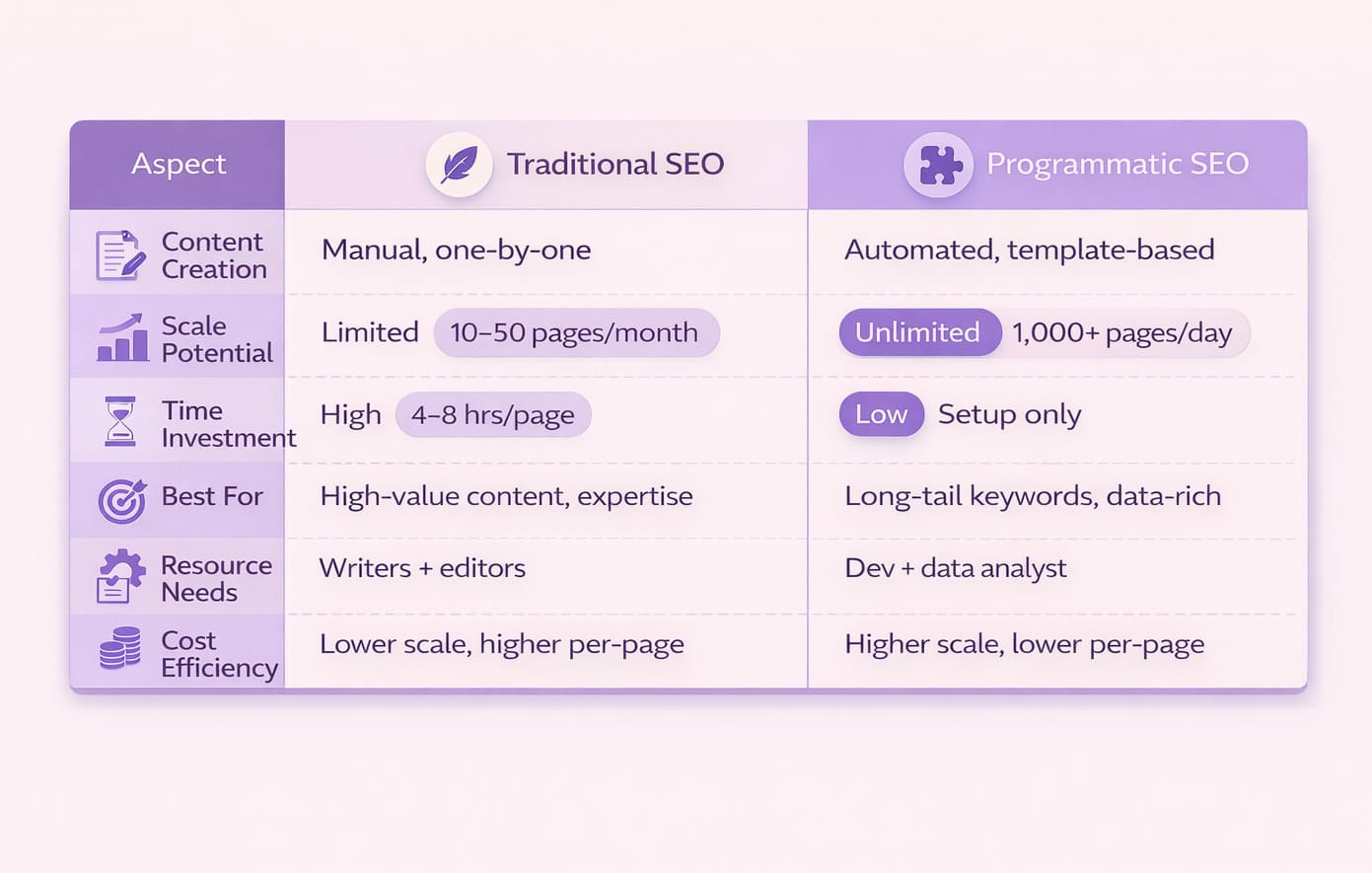
Traditional SEO involves manual content creation, one page at a time. Deep research, expert writing, and editorial oversight ensure high quality and consistent brand voice. This approach excels for thought leadership, complex topics requiring nuance, brand storytelling, and high-value conversion pages.
Comparison Framework:
| Dimension | Traditional SEO | Programmatic SEO |
|---|---|---|
| Content Creation | Manual writing, 4-8 hours per page, unique approach for each | Template-based SEO, automated content generation, minutes per page |
| Scale Potential | 10-50 pages monthly with dedicated team | 1,000+ programmatic content pages daily once system established |
| Resource Requirements | Writers, editors, subject matter experts | Developer, data analyst, initial template designer |
| Best Use Cases | Thought leadership, complex topics, brand storytelling | Long-tail coverage, data-rich content, location pages |
| Cost Efficiency | Higher cost per page, superior conversion potential | Lower cost at scale, efficient for volume plays |
| Time Investment | Weeks for planning, writing, optimization | Days for setup, minutes for each page thereafter |
Resource requirements highlight the fundamental difference. Traditional SEO demands ongoing creative labor for every page. Programmatic SEO front-loads technical setup, then scales effortlessly.
Scalability differentiates strategies, not quality. The hybrid approach maximizes coverage and authority:
- Use traditional SEO for pillar content and high-value pages that establish expertise
- Use programmatic SEO for supporting long-tail content that captures specific queries
- Let automated pages drive traffic to manually crafted conversion paths
Real project experience shows when each approach shines. Traditional SEO works best for company blog posts analyzing industry trends, comprehensive guides establishing thought leadership, and case studies showcasing customer success. Programmatic SEO excels at location pages for multi-city services, feature comparison pages for product catalogs, and integration directories for SaaS platforms.
The strategic combination creates a content ecosystem where automated scale feeds manual quality, generating more touchpoints while maintaining high standards for crucial conversion pages.
Frequently Asked Questions
What is programmatic SEO?
Programmatic SEO is an automated approach to creating hundreds or thousands of SEO-optimized pages by combining data-driven templates with structured datasets, enabling efficient targeting of long-tail keywords without manual page-by-page content creation.
What is the difference between programmatic SEO and SEO?
Traditional SEO focuses on manually creating high-quality individual pages, while programmatic SEO automates page generation using templates and data. Traditional SEO suits in-depth content; programmatic SEO excels at scaling long-tail keyword coverage efficiently.
How to create programmatic SEO?
Start by identifying target keywords, gather structured data, design reusable templates, choose a CMS platform (WordPress/Webflow), populate templates with data programmatically, ensure each page adds unique value, then deploy and monitor indexation and rankings.
What are examples of companies using programmatic SEO?
Zapier creates 50,000+ integration pages, Wise generates currency conversion pages, Nomad List builds city comparison pages, TripAdvisor produces location guides, and Yelp scales business listings – all using data-driven template approaches.
What are the pros and cons of programmatic SEO?
Pros: massive scalability, efficiency gains, long-tail keyword coverage, competitive advantage.
Cons: requires technical setup, data quality dependency, thin content risk, indexation challenges at scale, ongoing maintenance needs. Balance through strategic implementation.
How do I get started with programmatic SEO?
Begin with keyword research to identify scalable opportunities, audit available data sources, choose appropriate CMS platform, create one template manually first to validate the approach, then automate population and deployment processes gradually.
How does programmatic SEO work?
It combines reusable page templates with structured data from databases or APIs. The CMS populates template variables with unique data for each target keyword, automatically generating thousands of SEO-optimized pages that match specific search intents.
What tools do I need for programmatic SEO?
Essential tools include a CMS with custom fields (WordPress, Webflow), data sources (APIs, databases, spreadsheets), template builder, SEO optimization plugins, indexation monitoring tools (Google Search Console), and analytics platforms for performance tracking.
How long does it take to see results from programmatic SEO?
Initial indexation occurs within 2-4 weeks, with ranking improvements emerging after 2-3 months. Full traffic impact typically materializes in 4-6 months, depending on domain authority, competition level, and content quality.
What are common programmatic SEO mistakes to avoid?
Key mistakes include thin content without unique value, poor data quality, template design that creates duplicate content, ignoring technical SEO requirements, neglecting page speed at scale, and failing to monitor indexation coverage.
Can programmatic SEO work for small businesses?
Yes, when you have structured data and scalable keyword opportunities. Small businesses succeed with programmatic SEO for location pages, product comparisons, service area coverage, or directory-style content where data enables differentiation.
How do you avoid duplicate content in programmatic SEO?
Ensure each page has unique data combinations, add substantial unique content sections, implement canonical tags correctly, vary template structures where appropriate, enrich pages with additional context, and use schema markup for differentiation.
What is the best CMS for programmatic SEO?
WordPress excels with custom post types and extensive plugin ecosystem. Webflow offers visual flexibility with CMS collections. Custom solutions provide maximum control. Choose based on technical resources, scale requirements, and existing infrastructure.
 Share
Share
 X
X
 LinkedIn