



 336
336 


Today’s property buyers start with a Google search, often at 10 PM while scrolling through listings on their phones. Effective real estate marketing in 2026 requires a multi-channel digital approach. This approach involves combining high-impact visual content, targeted lead generation, and data-driven optimization tracking.
By implementing these digital marketing strategies, you can generate 2-5x more qualified leads, reduce time-to-sale by 30-45%, and achieve marketing ROI between 400-4,200%. Our comprehensive guide delivers the actionable property marketing strategies that top-performing agents use to dominate their markets and close more deals.

- Key Takeaways
- Understanding the Modern Real Estate Buyer's Journey
- Digital Marketing Foundations for Real Estate Success
- High-Impact Visual Marketing Strategies That Sell Properties Faster
- Lead Generation Techniques That Deliver Quality Prospects
- Content Marketing Strategies That Establish Authority
- Real Estate Marketing Campaign Building Framework
- Multi-Channel Marketing Approach for Maximum Visibility
- Measuring Success: Analytics and Optimization for Real Estate Marketing
- Frequently Asked Questions
Key Takeaways
- Digital-first buyer journey demands multi-channel presence: 97% of homebuyers start online, interacting with 8-12 channels over 10 weeks. Thus, real estate agencies require strategic visibility across SEO, social media, email, and visual content platforms.
- Visual content delivers the highest engagement ROI: 3D virtual tours increase engagement by 300% and generate 30-40% more qualified inquiries, while video marketing boosts conversions by 80%.
- Lead quality outweighs volume: Automated lead qualification and CRM-driven nurturing enable agents to generate 2-5x more qualified leads while reducing cost-per-acquisition to $25-150.
- Integrated measurement transforms marketing into investment: Tracking KPIs with proper attribution reveals true ROI by channel (email: 4,200%, SEO: 400-800%), enabling data-driven budget optimization.
Understanding the Modern Real Estate Buyer's Journey
According to the National Association of Realtors (NAR), 97% of homebuyers now use the internet during their property search. This is a dramatic shift in consumer behavior.
The modern property search spans an average of 10 weeks, during which buyers interact with 8-12 different digital channels before contacting an agent. This extended online research phase creates both challenges and opportunities for real estate professionals willing to adapt.
Consumer behavior data reveals that buyers now view an average of 10 properties online before scheduling a single in-person viewing. They’re conducting detailed research on neighborhoods, school districts, commute times, and local amenities — often before they’ve even identified specific properties of interest.
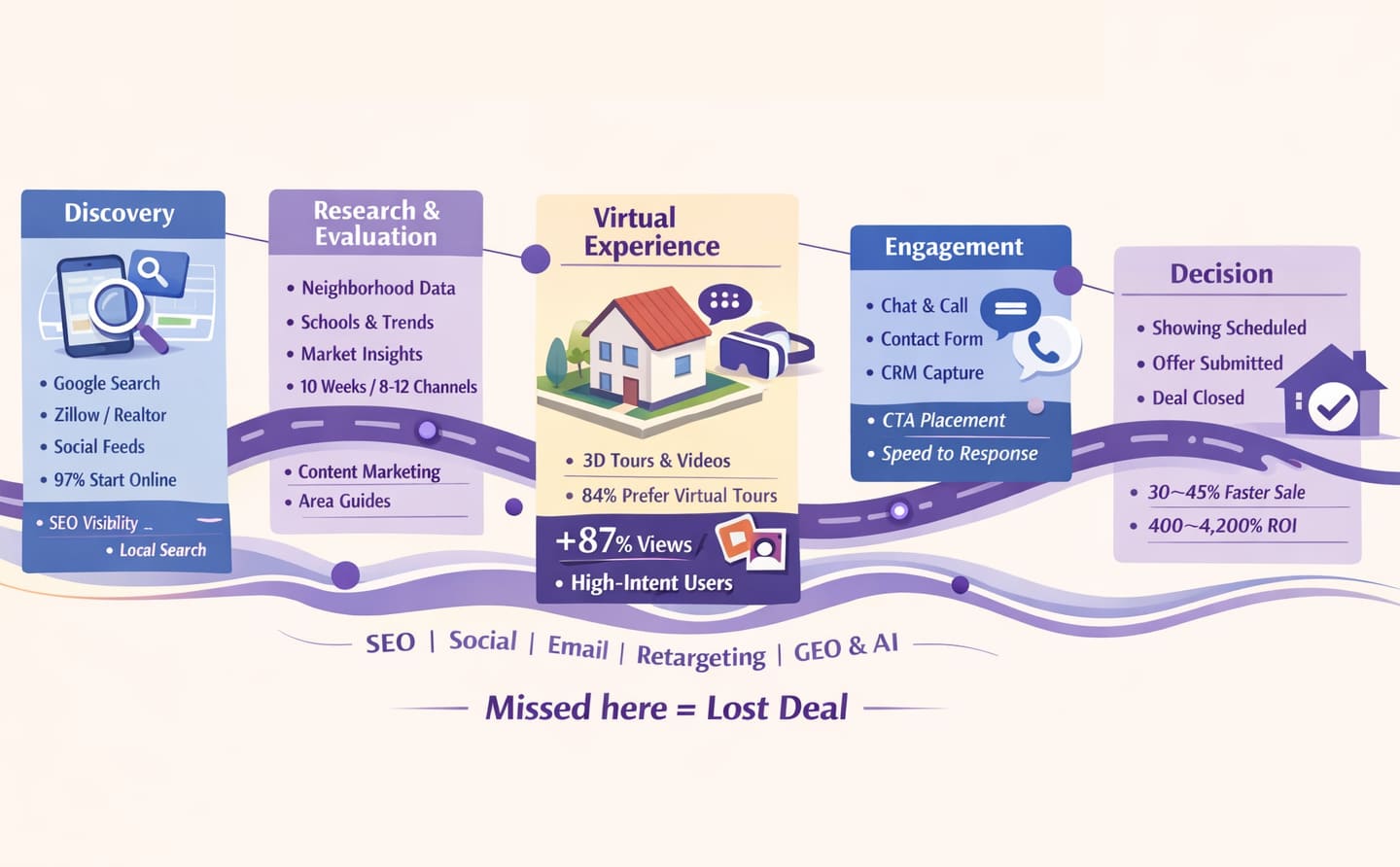
The Digital-First Buyer's Journey in Real Estate
95% of buyers start their search on a search engine or real estate website. Property listing discovery happens across multiple platforms: Zillow, Realtor.com, local MLS sites, and increasingly through social media feeds.
Virtual viewing has emerged as a decisive factor in the buyer decision process. Research shows that 84% of buyers prefer listings with virtual tours, and properties featuring 3D experiences receive 87% more views than those with photos alone.
The consumer research phase extends well beyond property details. Today’s buyers investigate:
- Neighborhood crime statistics and safety ratings
- School performance data and district boundaries
- Future development plans and zoning changes
- Historical property values and market trends
- Commute times to employment centers
Digital Marketing Foundations for Real Estate Success
Digital marketing for real estate professionals encompasses website optimization, online presence management, and search visibility. These three interconnected pillars determine your ability to capture and convert leads.
Marketing fundamentals haven’t changed: reach the right audience with the right message at the right time. What’s changed is how you execute.
The most common mistakes agents make include:
- launching paid advertising campaigns before optimizing their website for conversions,
- creating social media content without a defined strategy,
- neglecting local SEO while competitors dominate search results for neighborhood-specific queries.
Building a High-Converting Real Estate Website
Your website serves as the central hub of all real estate marketing efforts. Website conversion rates for real estate sites average 2-3%, but top performers achieve 8-12% through strategic user experience optimization.
Effective real estate websites prioritize:
| Channel | Average ROI | mplementation Cost | Timeframe to Results | Effectiveness Rating |
|---|---|---|---|---|
| SEO/Local SEO | 400-800% | $1,500-5,000/month | 3-6 months | 4.5/5 |
| Email Marketing | 4,200% | $200-1,000/month | 1-3 months | 4.8/5 |
| Social Media | 200-400% | $500-3,000/month | 2-4 months | 4.2/5 |
| PPC Advertising | 200-300% | $1,000-5,000/month | Immediate | 4.0/5 |
| 3D Virtual Tours | 300-500% | $200-500/property | Immediate | 4.7/5 |
Lead capture mechanisms must be strategically placed throughout your site. High-performing property listing pages include multiple contact options: instant chat, phone click-to-call, contact forms, and saved search sign-ups.
IDX integration enables seamless property search functionality, keeping visitors engaged on your site rather than leaving to search elsewhere.
As for web design, opt for:
- mobile-first layouts (60%+ of searches happen on mobile devices),
- fast loading speeds under 3 seconds,
- prominent calls-to-action above the fold.
SEO Strategies Specifically for Real Estate Professionals
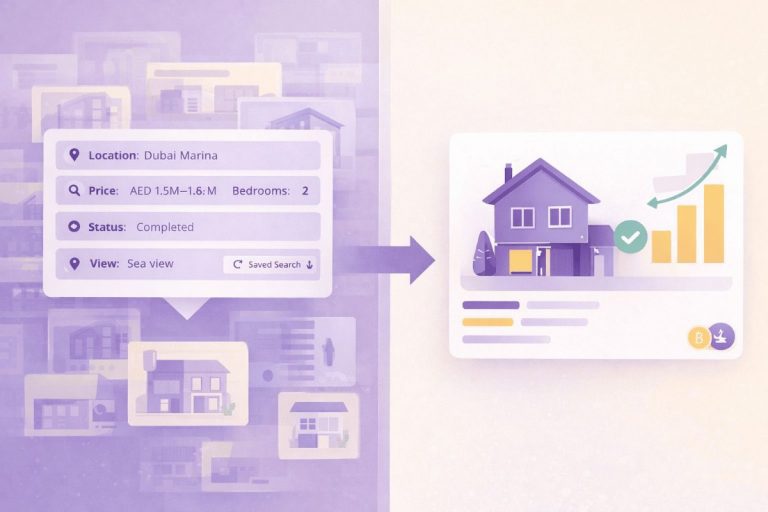
Search engine optimization for real estate demands a specialized approach focused heavily on local SEO. When buyers search “homes for sale in Dubai Marina,” your website needs to appear — and that requires targeted keyword research and consistent optimization efforts.
Local SEO dominates real estate search visibility. Over 70% of property searches include location-specific terms, making geographic optimization essential. Focus keyword strategy on:
- Neighborhood and subdivision names
- School district identifiers
- Property type + location combinations (“condos in downtown Austin”)
- “Near me” search optimization
LeadCraft’s SEO services focus specifically on real estate professionals. We optimize for high-value local keywords, manage Google Business Profile optimization across multiple locations, and build authoritative local citations that establish market expertise and drive 70%+ of qualified organic traffic.
Local SEO Optimization for Real Estate Markets
Google Business Profile optimization serves as the cornerstone of local search success. Complete profiles with accurate NAP (Name, Address, Phone) information, high-quality photos, and regular posts significantly improve Google Maps visibility.
Local search ranking factors specific to real estate include:
- Review quantity and quality (aim for 50+ reviews with 4.5+ star average)
- Local citation consistency across 40+ directories
- Neighborhood-specific landing pages with unique, valuable content
- Local backlinks from community organizations, news outlets, and business partners
- Geographic relevance signals from content and metadata
Neighborhood marketing through hyperlocal content establishes authority while capturing long-tail search traffic. Create comprehensive area guides covering schools, restaurants, parks, and community events — content that serves buyer needs while building local citations naturally.
Digital Tools Specific to Real Estate Marketing
Among CRM systems designed for real estate are Follow Up Boss, LionDesk, and kvCORE . They provide lead management tools that track interactions across channels, automate follow-up sequences, and score leads based on engagement patterns. Implementation typically increases revenue by 20-30% through improved lead nurturing and conversion.
Marketing automation capabilities within these platforms enable:
- Behavior-triggered email sequences
- Automated social media posting
- Lead scoring and routing
- Transaction management integration
- Performance analytics dashboards
When evaluating Software as a Service options, prioritize integration capabilities with your existing tech stack, mobile functionality for on-the-go agents, and scalability to support growth.
Implementing Chatbots and Live Chat for Property Websites
Chatbot technology has matured significantly. It makes automated lead qualification practical for real estate websites. Today’s AI-powered chatbots can answer common property questions, schedule showings, and capture lead information 24/7, when 40% of inquiries occur outside business hours.
Live chat software offers a hybrid approach: automated responses handle initial engagement while routing qualified conversations to available agents. This conversational marketing approach converts at 3-5x higher rates than traditional contact forms.
Implementation best practices include:
- Programming responses for top 20 frequently asked questions
- Setting clear expectations about response times
- Capturing essential lead information early in conversations
- Seamless handoff protocols to human agents
- Integration with CRM for complete lead tracking
Customer service technology investments typically pay for themselves within 2-3 months through increased lead capture and improved response times.
Programmatic Marketing for Real Estate
Programmatic advertising brings automation and precision to real estate display advertising at scale. Through real-time bidding on ad exchanges, agents can reach highly targeted audiences across thousands of websites without manual placement.
Audience targeting capabilities enable reaching:
- Recent real estate website visitors (retargeting)
- Users matching homebuyer demographic profiles
- People researching mortgage rates or moving services
- Residents in specific geographic areas
- Lookalike audiences based on past client data
Digital advertising through programmatic channels delivers 30-40% lower cost-per-impression compared to traditional display buying. Performance metrics show 2-3x higher click-through rates when targeting is properly configured.
High-Impact Visual Marketing Strategies That Sell Properties Faster
Property photography quality directly correlates with listing performance. Houses with professional photos are sold 32% faster and for higher prices than those with amateur images.
Today’s buyers expect video tours, 360-degree photography, and interactive 3D experiences as standard features, not premium add-ons.
Smartphone photos no longer suffice for competitive markets. Investment in quality visual merchandising, including staging, lighting, and professional editing, typically returns 5-10x the cost through faster sales and higher offers.
Virtual Tours and 3D Experiences: The New Open House Standard
3D visualization technology enables buyers to explore properties remotely with unprecedented detail, fundamentally changing how the traditional open house functions.
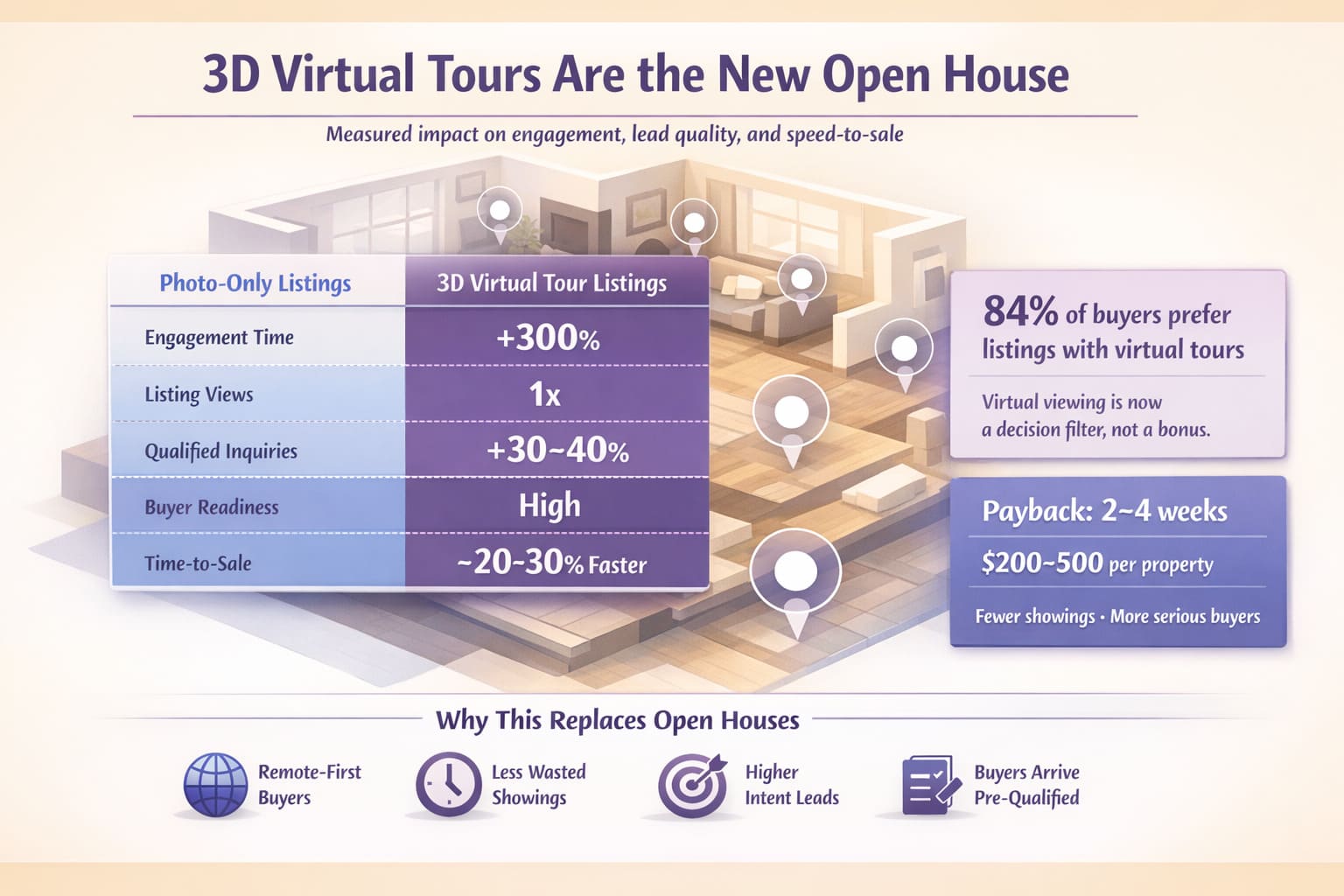
Matterport leads the virtual reality property tour market, though alternatives like 360-degree photography solutions from Ricoh Theta and Insta360 offer lower-cost entry points at $200-500 per property. The technology investment pays back within 2-4 weeks through reduced showing time and increased qualified inquiries.
Creating Video Content That Captures Buyer Interest
Viewers retain 95% of a message when watching video compared to 10% when reading text. For real estate, this translates directly to buyer interest and property memorability.
YouTube optimization for property videos requires attention to titles, descriptions, and tags that match buyer search patterns. Property tour videos should include neighborhood context, not just interior walkthroughs, to answer the questions buyers actually have.
Aerial footage showcases lot sizes, neighborhood character, and proximity to amenities in ways ground-level photography cannot. Investment ranges from $150-500 per property for professional drone video production.
Social media marketing distribution multiplies video reach across platforms. Content should be adapted for the social platform — vertical for Instagram Stories and TikTok, horizontal for YouTube and Facebook.
Lead Generation Techniques That Deliver Quality Prospects
Generating hundreds of unqualified leads wastes time and resources while producing minimal results. The focus must shift to lead qualification strategies that identify prospects with genuine intent and purchasing capability.
The sales funnel for real estate operates differently than most industries. With purchase cycles spanning months and high transaction values, target marketing precision becomes critical. Every marketing dollar should work toward attracting prospects who match your ideal client profile.
Digital Marketing for Real Estate Lead Capture
Landing page optimization drives digital marketing for real estate lead capture success. Single-purpose pages designed around specific offers convert at 5-15%, dramatically outperforming general website contact forms at 1-2%.
Effective lead magnet options for real estate include:
- Home valuation tools (highest conversion rates at 10-15%)
- Neighborhood market reports
- First-time buyer guides
- Investment property calculators
- Exclusive off-market listing alerts
Minimize required fields for initial capture (name, email, phone), then gather additional information through progressive profiling. Every additional form field reduces conversion rate by approximately 10%.
Call to action placement follows the “don’t make them scroll” principle. Primary CTAs appear above the fold, with reinforcement CTAs throughout longer content. Digital marketing tools like OptinMonster, Leadpages, and Unbounce enable rapid landing page testing and conversion rate optimization without developer resources.
Building Effective Real Estate Advertising Campaigns
Online advertising for real estate requires platform-specific approaches tailored to where your target audience spends time and how they search for properties.
Platform comparison for real estate advertising:
Google Ads excels at capturing high-intent searches — people actively looking for homes in specific areas. Pay-per-click advertising on Google typically costs $1-5 per click for real estate keywords, with cost-per-lead ranging $20-80 depending on market competition.
Facebook Ads offer superior demographic and behavioral targeting. The platform’s ability to reach users based on life events (new job, engagement, growing family) makes it powerful for prospecting. Cost-per-lead typically ranges $5-25, though lead quality may require additional qualification.
Display advertising through Google Display Network and programmatic channels works best for retargeting past website visitors and building brand awareness in target geographic areas.
Creating Compelling Real Estate Offers
Your value proposition must resonate with specific buyer motivations to drive action. Generic “I’ll help you find your dream home” messaging fails to differentiate in competitive markets.
Effective unique selling proposition development requires identifying what specifically you offer that competitors don’t:
- Specialized neighborhood expertise
- Exclusive access to off-market listings
- Innovative marketing for sellers
- Specialized buyer programs (relocation, investment, first-time)
- Technology-enabled service advantages
Marketing offer creation applies sales psychology principles — urgency, exclusivity, and social proof trigger conversion triggers that motivate action. Examples include:
- “See homes 24 hours before they hit the market”
- “Join 500+ families we’ve helped find homes in Dubai Marina”
- “Free home warranty included with every purchase”
Customer incentives must provide genuine value while differentiating your service. The key is alignment between offer and audience — first-time buyers respond to educational resources while investors prioritize ROI analysis tools.
Content Marketing Strategies That Establish Authority
Your industry expertise represents tremendous value to buyers and sellers navigating complex decisions. Packaging that knowledge into accessible content establishes authority while serving genuine client needs.
Market reports covering price trends, inventory levels, and neighborhood developments position you as the go-to source for market intelligence. Blog content addressing common buyer and seller questions captures search traffic while nurturing leads through extended decision timelines.
As AI-powered search transforms how buyers discover information, ensuring your expertise appears in AI responses becomes critical. LeadCraft’s Generative Engine Optimization services position your content for citations in ChatGPT, Claude, and Perplexity responses.
Leveraging Social Media for Property Marketing
Social media marketing for real estate demands platform-specific strategies that align content format with audience expectations and platform algorithms.
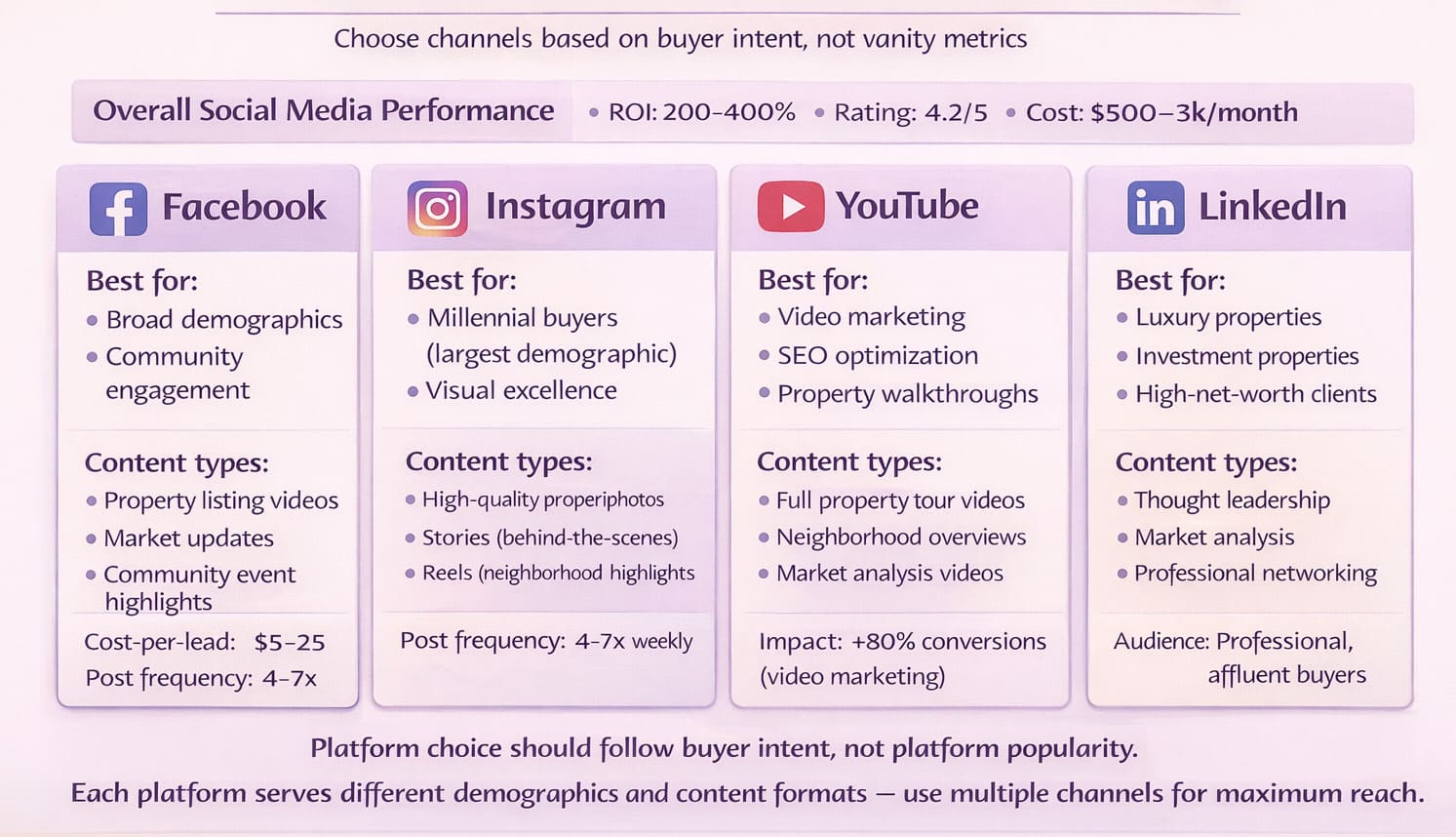
Facebook remains dominant for real estate with its broad demographics and robust advertising platform. Optimal content includes listing videos, market updates, and community event highlights. Post frequency: 4-7 times weekly.
Instagram prioritizes visual excellence. High-quality property photos, Stories with behind-the-scenes content, and Reels featuring neighborhood highlights drive audience engagement. The platform skews younger, making it essential for reaching millennial buyers (now the largest buying demographic).
LinkedIn serves the luxury and investment property segments effectively. Thought leadership content, market analysis, and professional networking generate referral relationships and attract high-net-worth clients.
Community Engagement as a Marketing Strategy
Community relations extend your marketing beyond digital channels into real-world relationships that generate referrals and repeat business. Local marketing through genuine community involvement builds recognition that paid advertising cannot replicate.
Effective event sponsorship opportunities include:
- Youth sports teams and leagues
- School fundraisers and events
- Community festivals and celebrations
- Local charity organizations
- Chamber of Commerce activities
Track business impact from community involvement through source attribution in your CRM. Many agents find that 20-40% of closed business traces back to community relationship marketing over time.
Real Estate Marketing Campaign Building Framework
Campaign strategy begins with clear objectives tied to business goals. Are you launching in a new geographic area? Building listing inventory? Attracting a specific buyer demographic? Each objective demands different tactics and success metrics.
Your marketing plan should document:
- Target audience definition and personas
- Channel selection and budget allocation
- Content calendar and production schedule
- Performance benchmarks and KPIs
- Testing and optimization protocols
Strategic planning frameworks like SMART goals (Specific, Measurable, Achievable, Relevant, Time-bound) bring discipline to campaign management. Integrated marketing communications ensure consistent messaging across all touchpoints — critical when prospects may encounter your marketing across multiple channels before engaging.
Defining Campaign Goals and Key Performance Indicators
Key performance indicator selection must align with actual business objectives, not vanity metrics. Tracking followers gained means nothing if those followers never convert to leads or clients.
Essential marketing goals and corresponding marketing metrics:
Awareness campaigns:
- Reach and impressions
- Website traffic from new visitors
- Brand search volume
Lead generation campaigns:
- Cost per lead
- Lead volume by source
- Lead quality scores
Nurturing campaigns:
- Email open and click rates
- Content engagement metrics
- Lead progression through funnel stages
Conversion campaigns:
- Cost per acquisition
- Conversion rates by channel
- Return on ad spend
Performance measurement systems should connect marketing activities to closed transactions. This requires tracking beyond initial lead capture through your CRM to attribute revenue back to originating campaigns.
Multi-Channel Marketing Approach for Maximum Visibility
Reaching prospects requires presence across the marketing channels prospective buyers use. These channels vary by demographic, location, and stage of the buying journey.
The evolution toward omni-channel marketing demands more than just presence on multiple platforms. True integrated marketing communications create seamless experiences where each channel reinforces others, brand consistency remains strong, and leads can engage through whichever channel they prefer.
Email Marketing Strategies for Nurturing Real Estate Leads
Email marketing delivers the highest ROI of any marketing channel — 4,200% average return for real estate when executed strategically. The key lies in drip campaign sophistication that matches message to prospect stage and behavior.
Email automation enables personalized communication at scale. Rather than blasting identical messages to your entire database, behavioral triggers send relevant content based on actions:
- New lead → Immediate response + introduction sequence
- Property page visit → Related listing alerts
- Market report download → Monthly market update enrollment
- Extended inactivity → Re-engagement sequence
Email engagement optimization tactics:
- Personalized subject lines (increase open rates 26%)
- Mobile-optimized design (60%+ opens on mobile)
- Clear single call-to-action per email
- A/B testing of send times and content
- Regular list hygiene to maintain deliverability
Marketing automation platforms like Mailchimp, ActiveCampaign, or real estate-specific solutions automate email sequence management while providing analytics to optimize performance continuously.
Implementing an Effective Cross-Channel Content Strategy
Content strategy for multi-channel success requires both consistency and adaptation. Core messages remain stable while execution varies by platform requirements and audience expectations.
Cross-channel marketing coordination starts with content pillars — key themes that define your expertise and value proposition. These pillars inform content distribution across channels:
- Educational content → Blog posts, email newsletters, LinkedIn articles
- Property showcases → Instagram, Facebook, YouTube, listing sites
- Market insights → Email reports, social media graphics, video commentary
- Community content → Facebook groups, local partnerships, event coverage
Content adaptation transforms single assets for multiple uses. A market report becomes a blog post, infographic, video summary, email series, and social media content — maximizing production investment through strategic channel optimization.
Measuring Success: Analytics and Optimization for Real Estate Marketing
Marketing analytics transform guesswork into strategy. Without data-driven decision making, you’re spending money based on assumptions — a recipe for wasted budgets and missed opportunities.
Return on investment measurement separates professional marketing from amateur efforts. Every channel and campaign should justify its existence through measurable contribution to business outcomes. Performance metrics tracked consistently reveal what works, what doesn’t, and where optimization yields the greatest improvements.
Google Analytics provides foundational website data — traffic sources, user behavior, conversion tracking — essential for understanding how prospects interact with your online presence. Marketing measurement extends beyond website analytics to encompass the entire prospect journey, creating visibility into the full funnel from first touch through closed transaction.
ROI Tracking and Attribution Models for Real Estate
Return on investment calculation for real estate marketing requires connecting marketing spend to closed transactions — often months after initial contact. This demands robust tracking infrastructure and appropriate marketing attribution models.
Multi-touch attribution recognizes that real estate purchases involve numerous interactions across channels over extended periods. A closed transaction might trace back to:
- Initial contact through Google search
- Nurturing through email sequences
- Re-engagement via Facebook retargeting
- Final conversion through direct outreach
Attribution modeling options include:
| Model | Description | Best For |
|---|---|---|
| First-touch | Credits first interaction | Understanding initial discovery |
| Last-touch | Credits final conversion action | Measuring closing channels |
| Linear | Equal credit across all touches | General multi-channel view |
| Time-decay | Weighted toward recent touches | Long sales cycles |
| Position-based | 40% first, 40% last, 20% middle | Balanced attribution |
Customer acquisition cost benchmarks for real estate typically range $20-150 per qualified lead depending on market and channel, with total client acquisition costs of $500-2,500 for a closed transaction. Tracking these marketing metrics enables meaningful ROI calculation and budget optimization.
Implement tracking through UTM parameters on all links, CRM source attribution, and regular reconciliation between marketing data and closed transaction reports. This systematic approach reveals true marketing ROI by channel and campaign — knowledge that transforms marketing from expense to investment.
Frequently Asked Questions
What are the most effective digital marketing strategies for real estate?
The most effective strategies combine local SEO (generating 70%+ of organic traffic), email marketing (4,200% ROI), social media marketing ($2-15 cost-per-lead), and high-quality visual content including 3D virtual tours (300% engagement increase). Success requires integrating these channels into a cohesive system rather than pursuing isolated tactics.
How can real estate agents measure the success of their marketing campaigns?
Track key performance indicators including cost-per-lead, lead quality scores, conversion rates by channel, and ultimately cost-per-acquisition tied to closed transactions. Implement multi-touch attribution modeling to understand how different channels contribute throughout the 3-12 month buyer journey. Google Analytics, CRM reporting, and platform-specific analytics combine to provide comprehensive performance visibility.
How do immersive 3D tours help attract the right buyers and win more listings?
3D virtual tours increase listing engagement by 300% and generate 30-40% more qualified inquiries. Properties with virtual tours sell 20-30% faster and attract more serious buyers — those who have already “walked through” virtually arrive at showings more prepared to make decisions. For listing presentations, offering Matterport or similar technology differentiates your services from competitors still relying on photos alone.
How can social media marketing generate property leads?
Social media generates leads through targeted advertising (Facebook’s demographic targeting reaches specific buyer profiles at $5-25 per lead), organic content that builds audience and referral relationships, and retargeting campaigns that re-engage website visitors. Platform selection matters: Instagram excels for visual property marketing, Facebook provides the broadest reach and advertising capabilities, LinkedIn serves luxury and investment segments effectively.
What is the ROI of digital marketing for real estate professionals?
ROI varies significantly by channel: email marketing averages 4,200% return, SEO generates 400-800% over time, social media delivers 200-400%, and paid advertising ranges 200-300%. Overall, integrated digital marketing approaches achieve 400-4,200% ROI compared to traditional methods. The key is consistent measurement and optimization — tracking spending through to closed transactions to calculate true return on investment.
 Share
Share
 X
X
 LinkedIn