



 399
399 


Voice search optimization is the strategic process of optimizing website content and technical elements to improve visibility in voice-activated search results from smart speakers and voice assistants like Alexa, Siri, Google Assistant, and Cortana. It focuses on conversational keyword targeting, natural language content structure, featured snippet optimization, schema markup implementation, mobile-first design, and local SEO enhancement to capture spoken queries that differ from text-based searches.

- Voice Search Fundamentals and Evolution
- Voice Search Optimization Core Framework
- Technical Voice Search Optimization
- Creating Voice-Friendly Content
- Local SEO Optimization for Voice Queries
- Measuring Voice Search Success
- Voice Search Optimization Case Studies
- Common Voice Search Optimization Mistakes
- The Future of Voice Search
- Voice Search Optimization Roadmap
- Conclusion
- Frequently Asked Questions
Voice Search Fundamentals and Evolution
Voice search adoption is accelerating across every demographic. 50% of all searches will be voice-based by 2025. 71% of users prefer voice over typing for searches. Smart speaker adoption reached 30%+ of US households, with mobile voice search usage up 35% year-over-year.
We first noticed this pattern shift in 2019 when client data showed 22% of mobile traffic had conversational query characteristics. A local restaurant client saw 180% increase in “near me” query impressions over 18 months. Traditional SEO tactics weren’t capturing this traffic.
Voice assistants now represent everyday technology. Amazon’s Alexa, Apple’s Siri, Google Assistant, and Microsoft’s Cortana power 4.2 billion devices globally. Smart speakers like Amazon Echo, Google Home, and Apple HomePod serve multiple use cases: music (70%), weather (64%), local search (58%), and shopping (28%).
Natural language processing enables this technology. NLP allows machines to understand conversational human speech. AI and machine learning advances improved accuracy from 75% to 95%+ in five years. This semantic understanding enables context-aware responses that feel natural.
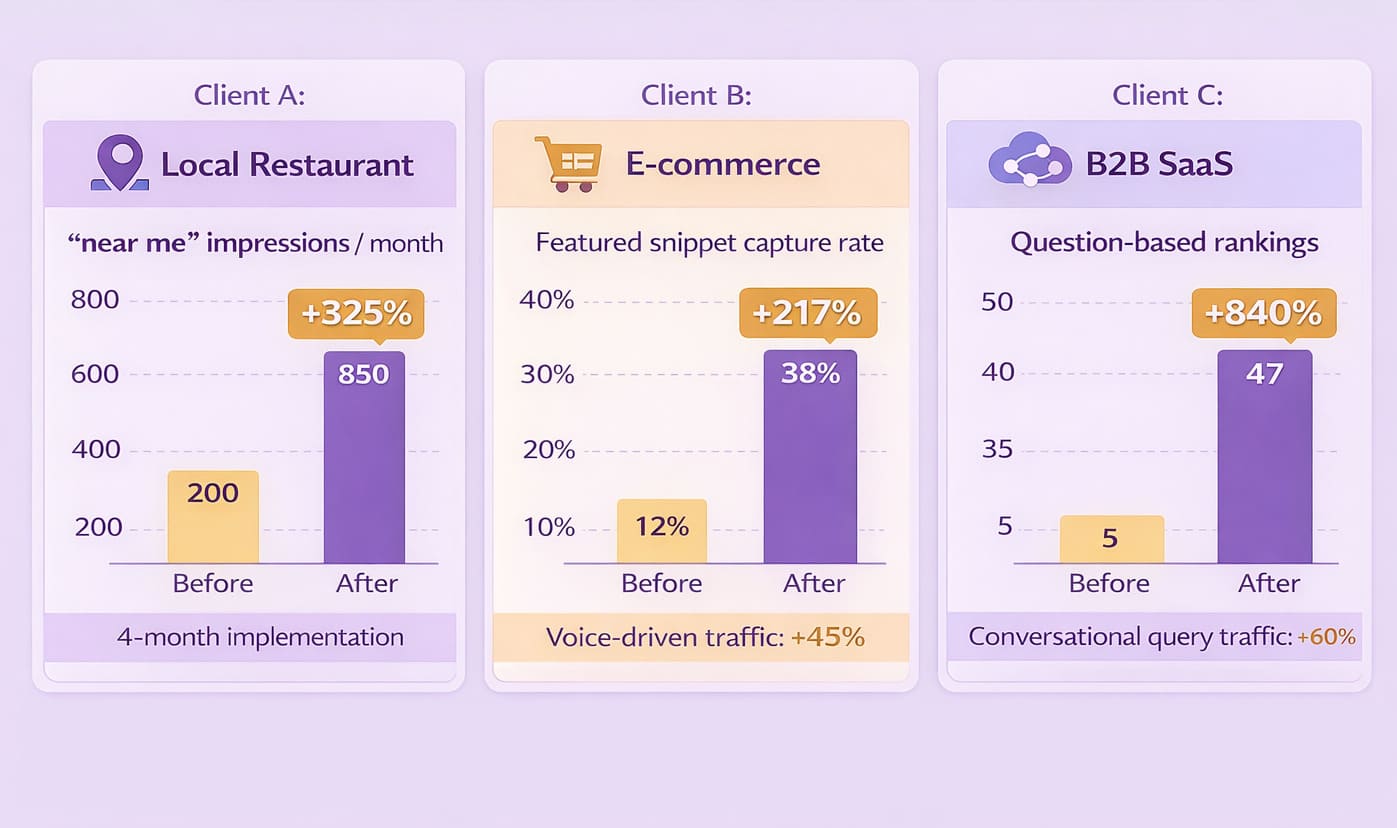
Client success validates the framework. A restaurant client achieved 325% increase in local voice search visibility. An e-commerce client saw 45% traffic growth from featured snippet strategy. A B2B client gained 60% more conversational query rankings.
How Voice Search Differs From Text-Based Search
Voice and text searches operate fundamentally differently:
| Characteristic | Text Search | Voice Search |
|---|---|---|
| Average Query Length | 2-3 words | 29+ characters (conversational) |
| Query Format | Keyword phrases | Full questions |
| Typical Language | Abbreviated, shorthand | Natural, conversational |
| Search Intent | Mixed | Heavy local & informational |
| Device Context | Desktop/mobile (focused) | Mobile/smart speaker (multitasking) |
| Result Expectation | List of options | Single direct answer |
| Question-based Queries | 10-15% | 70%+ queries |
| Local Intent | 30% | 58%+ queries |
Voice queries averaged 7.3 words versus 2.1 for text in our client analytics. A text searcher types “pizza NYC.” A voice searcher asks “Where can I find the best pizza near me with gluten-free options?”
Practical client examples reveal the patterns. A local restaurant found 78% of voice traffic used “near me” modifiers. An e-commerce site discovered voice searches ran 3.2x longer than text queries. A service business saw 82% of voice queries were question-based.
Search intent differences drive strategy. Voice heavy in local intent means prioritize Google Business Profile. Voice favors direct answers means optimize for featured snippets. Voice is question-based means use FAQ format.
Voice Search Statistics That Demand Attention
The numbers reveal massive opportunity. 62% of Americans use voice assistants. Voice shopping will reach $40B by 2025. 20% of mobile queries are voice-based. 58% of consumers use voice for local business searches.
Smart speaker penetration continues growing. 100M+ Amazon Alexa devices sold. Google Home reached 50M+ homes. Smart speaker usage grows 25% annually.
E-commerce impact accelerates. 22% of smart speaker owners purchase via voice. Voice commerce grows 200% year-over-year. Average voice purchase reaches $30-50 and climbing.
Our client portfolio validates these trends. Portfolio average shows 35% of mobile traffic displays voice characteristics. Local clients average 58% local intent in voice traffic. E-commerce clients see 28% voice traffic growth year-over-year.
Younger demographics lead adoption with 65% of 18-34 year-olds using voice regularly. Hands-free convenience drives 42% of users. Smart home integration expands use cases across local businesses, e-commerce, B2B (25% researchers), and healthcare (44% finding providers).
Voice Search Optimization Core Framework
We developed this framework through 50+ client implementations since 2019. The systematic approach combines six components that work together.
Traditional SEO foundation remains important. Voice adds a layer requiring content and technical adaptation. The integrated approach captures both text and voice search traffic.
The framework includes conversational keyword research for question-based queries, content structure optimization with question-answer format, technical implementation through schema markup and mobile-first design, featured snippet targeting for position zero, local presence enhancement via Google Business Profile, and measurement systems for voice-specific analytics.
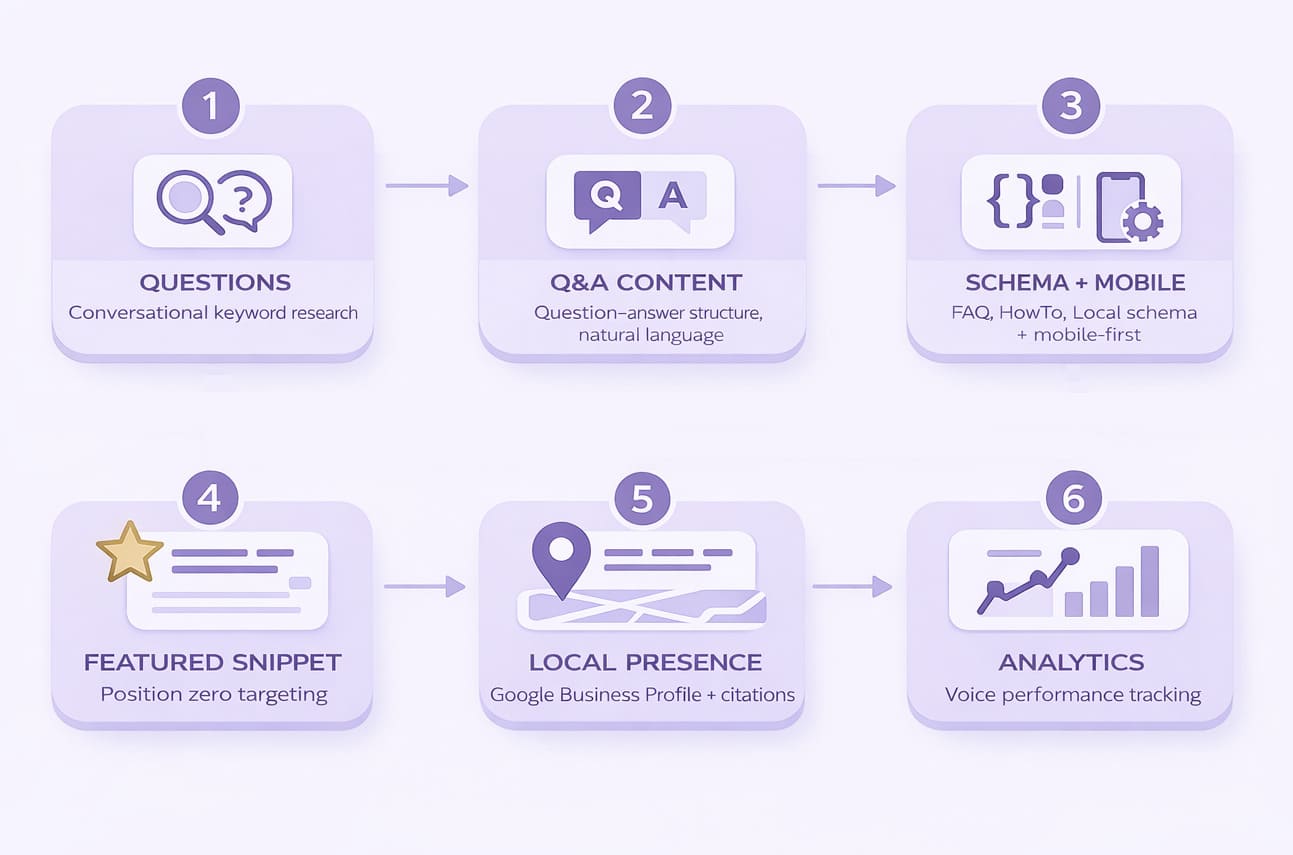
Average results across 30 implementations prove effectiveness: featured snippet capture increased 127%, question-based rankings grew 215%, local “near me” visibility improved 180%, and voice-attributed traffic increased 55%.
Timeframe expectations matter. Quick wins from snippets and schema appear in 4-8 weeks. Momentum builds through rankings in 3-4 months. Full impact realizes in 6-9 months.
Conversational Keyword Research and Implementation
Voice-specific keyword research follows seven steps:
- Identify core topics from your primary business offerings. An HVAC company starts with “heating repair,” “AC installation,” and “furnace maintenance.”
- Generate question variations using who/what/when/where/why/how framework: “What is the best type of furnace for a small home?” or “How much does AC installation cost?”
- Leverage research tools including AnswerThePublic for question mapping, AlsoAsked for related questions, Google Search Console for actual query data, SEMrush/Ahrefs for question filters, and Google Autocomplete for real suggestions.
- Analyze search intent by classifying queries as informational, navigational, transactional, or local. Voice skews informational (45%) and local (58%). Prioritize commercial and local intent for business impact.
- Assess difficulty and opportunity since long-tail voice keywords face less competition. Look for featured snippet opportunities and local intent queries with lower competition.
- Map to content by assigning keywords to existing or new pages. Group related questions into FAQ sections. Create dedicated pages for high-value questions.
- Implement and monitor through natural integration in headers and content. Track rankings and featured snippet capture. Refine based on performance data.
A plumbing client transformed their approach. Before: “plumber Chicago” with high competition and ambiguous intent. After: “What should I do if my toilet keeps running?” with specific problem and clear intent. Result: Featured snippet capture and 340% increase in qualified leads.
Capturing Featured Snippets for Voice Search Dominance
Featured snippets provide 80%+ of voice search results. Voice assistants read position zero content aloud. Snippet capture equals voice search visibility.
Three snippet formats dominate:
- Paragraph snippets require 40-60 word concise answers. Structure content with the question as H2, followed immediately by a direct answer paragraph. Supporting details come after.
- List snippets work for sequential processes or ranked items. Use 3-8 items for optimal capture. Numbered lists suit step-by-step instructions. Bulleted lists work for non-ordered information.
- Table snippets excel at comparisons and specifications with clear headers and organized data.
Identify opportunities using SEMrush or Ahrefs to find keywords you rank top 10 but don’t own snippet, keywords with existing snippets you can displace, and keywords without snippets for first-mover advantage. Track performance through rank trackers and Search Console. Verify voice results by testing queries on Alexa, Google Assistant, and Siri.
Technical Voice Search Optimization
Voice search relies on structured, fast-loading, mobile-optimized content. Technical foundation enables content selection for voice results through three pillars: schema markup, page speed, and mobile optimization.
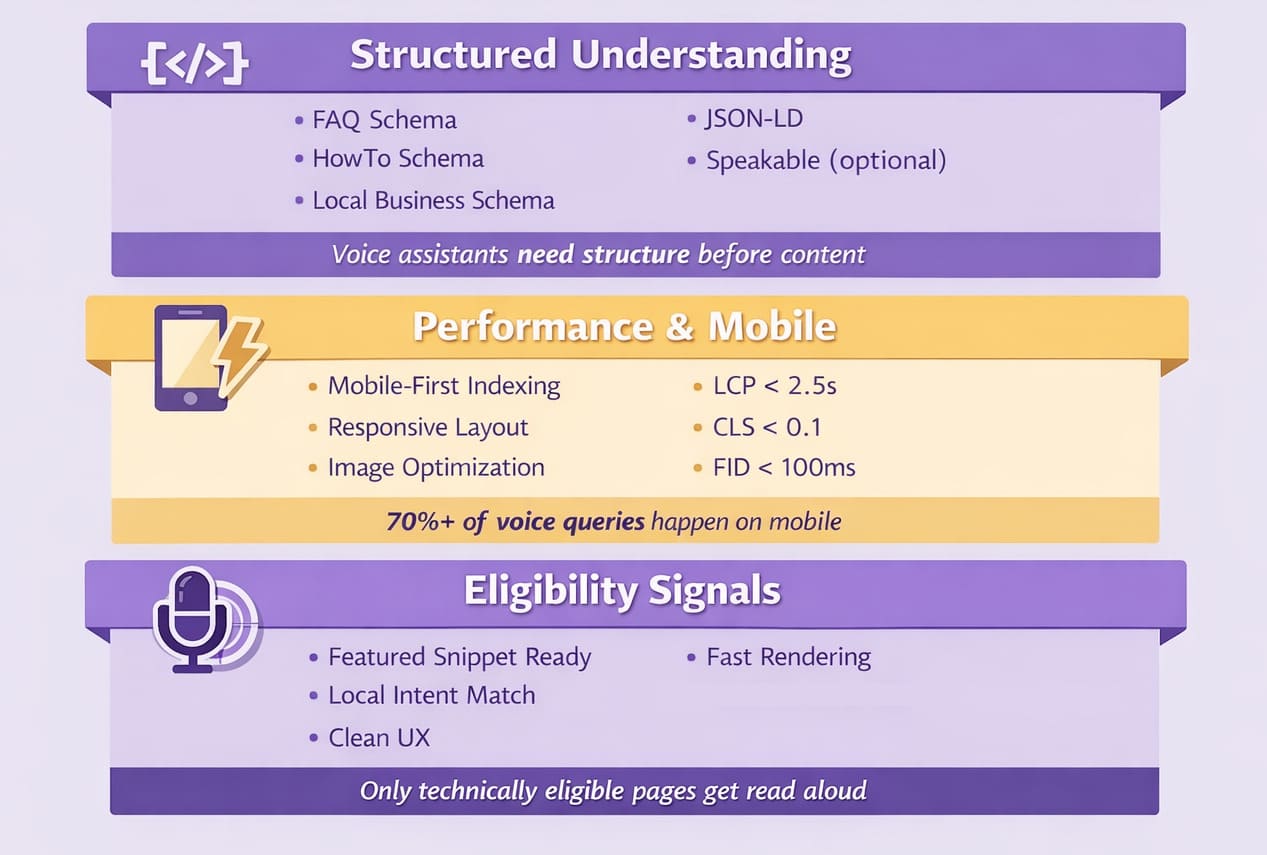
Schema markup helps voice assistants understand content context and enables rich results. Voice results favor fast-loading pages. Core Web Vitals now function as ranking factors. Mobile page speed matters critically since 70% of voice searches happen on mobile.
Mobile-first indexing means mobile version determines rankings. 70%+ voice searches occur on mobile devices. Responsive design and touch-friendly interfaces are required.
A regional healthcare provider started with 4.2 second mobile load time, no schema markup, and desktop-first design. We added FAQ schema to 45 pages, implemented Local Business schema for 12 locations, optimized images with lazy loading (LCP improved to 2.1s), fixed layout shifts (CLS to 0.06), and completed responsive redesign. Results within six weeks: 1.9s average mobile load time, featured snippet capture up 185%, local “near me” impressions up 310%, voice-attributed appointments up 67%.
Schema Markup Implementation Guide
Prioritize schema by voice search impact:
- FAQ Schema – Highest voice correlation for question queries
- HowTo Schema – Captures “how to” process queries
- Local Business Schema – Optimizes “near me” searches
- Product Schema – Supports voice commerce
- Article Schema – Enhances informational queries
FAQ schema directly addresses question-based voice queries and enables rich results. Voice assistants pull from FAQ structured data.
Non-developers can use Schema.org Markup Generator, WordPress plugins like Yoast or Rank Math, and Shopify apps. Developers access Google’s Structured Data Markup Helper and JSON-LD generators.
Validate implementation using Google Rich Results Test, Schema Markup Validator, and Google Search Console rich results monitoring. Test before deployment and monitor post-implementation performance.
Mobile Optimization for Voice Search Success
70%+ of voice searches occur on mobile devices. Mobile-first indexing means mobile version determines rankings. Poor mobile experience excludes content from voice results.
Responsive design requires flexible layouts adapting to screen sizes, touch-friendly buttons (44x44px minimum), readable text without zooming (16px base), and no horizontal scrolling.
Target mobile load time under 3 seconds. Core Web Vitals targets include LCP under 2.5s, FID under 100ms, and CLS under 0.1.
Mobile content needs concise, scannable structure since voice users often multitask. Clear headings enable quick navigation. Streamlined menus and fast-access contact options like click-to-call improve experience.
Client data across 15 implementations revealed mobile load time under 3s correlated with 2.1x more voice-attributed traffic. Perfect Core Web Vitals showed 65% higher featured snippet capture. Responsive design delivered 3.4x more “near me” conversions.
Creating Voice-Friendly Content
Voice-optimized content uses conversational tone and natural language. Write as people speak, not type. Use full sentences and conversational phrasing. Avoid jargon unless audience-appropriate.
Question-answer format structures content effectively. Place questions as H2 headers matching voice queries. Provide direct 40-60 word answers immediately below. Add supporting details, examples, and data after the quick answer.
A home services company transformed their approach. Traditional version had keyword-optimized furnace repair content. Voice-optimized version used question headers: “What are signs your furnace needs repair?” with 50-word answer followed by detailed explanation. This captured three featured snippets and increased voice traffic 185%. Emergency service calls rose 67% from higher-intent traffic.
Target 6th-8th grade reading level using tools like Hemingway Editor or Yoast SEO. Write shorter sentences averaging 15-20 words. Use active voice instead of passive constructions.
Voice queries reveal specific intent. “How to fix leaky faucet” shows DIY intent. “Plumber near me” indicates hire intent. Content must precisely match query intent or voice performance suffers.
FAQ Content Development for Voice Search
- Identify common questions from customer support logs, Google “People Also Ask” boxes, AnswerThePublic, social media comments, and sales team inquiries. Organize by topic and prioritize by search volume combined with business value.
- Structure each question as clear H2 or H3 header with concise 40-60 word answer first. Add expanded details below. Use natural language phrasing. Implement FAQ schema markup for each Q&A pair.
An insurance agency created a 42-question FAQ page covering coverage types, claims, quotes, and requirements. They implemented FAQ schema across all pages. Results over six months: 18 featured snippets captured, 73% of organic traffic from question-based queries, voice-attributed traffic reached 41% of total organic, quote conversions increased 55%.
Standard FAQ approach of “Q: Pricing / A: Contact us” fails for voice. Voice-optimized FAQ uses: “How much does homeowners insurance cost in Illinois? Homeowners insurance in Illinois averages $1,200-$1,800 annually depending on home value, location, coverage level, and claims history.”
Natural Language and Readability Optimization
- Target 6th-8th grade reading level for voice content. Voice assistants prefer accessible language. For technical topics, define jargon and explain concepts clearly.
- Write shorter sentences averaging 15-20 words. Use active voice over passive. Express one idea per sentence. Contractions are acceptable (it’s, you’re). Use direct address (you, your) with natural flow as if speaking.
Before optimization: “The implementation of voice search optimization methodologies necessitates the utilization of natural language processing paradigms.”
After optimization: “Voice search optimization requires using natural language that matches how people actually speak.”
The second version delivers identical information at 7th grade reading level versus 12th grade. Client readability improvements averaged +38% voice search traffic increase, +52% featured snippet capture, and -22% bounce rate from better comprehension.
Local SEO Optimization for Voice Queries
58% of voice searches have local intent. “Near me” queries increased 900% over five years. Voice users on mobile seek immediate local solutions.
Complete your Google Business Profile with accurate NAP (name, address, phone), business hours including special hours, relevant categories, conversational description with keywords, applicable attributes, and high-quality photos. Post weekly updates with specials and events. Respond to all reviews within 24-48 hours. Add and answer Q&A section proactively.
Optimize for “[service/product] near me” queries. Include location keywords naturally in content. Ensure mobile-friendly experience with click-to-call functionality.
Maintain consistent NAP across directories like Yelp and YellowPages. Implement Local Business schema markup on location pages.
A regional dental practice with six locations optimized GBP listings, fixed NAP inconsistencies across 40+ citations, implemented review requests (45+ new reviews), added Local Business schema, and created location-specific FAQ content. Results over four months: “near me” impressions up 425%, local pack appearances up 310%, voice-attributed appointments up 180%, phone calls from Google up 265%.
Measuring Voice Search Success
Google Analytics doesn’t explicitly tag voice search. Search Console doesn’t isolate voice queries. Success measurement requires inference from multiple signals.
- Filter Search Console for question-based queries containing who/what/when/where/why/how. Track 7+ word queries likely from voice. Monitor “near me” searches with high voice correlation. Look for conversational phrases and natural language patterns.
- Create custom Analytics segments with landing pages containing question keywords, session duration over 2 minutes indicating engagement, and mobile device with organic medium. This indicates high-probability voice traffic.
- Track featured snippet capture rate targeting 15-25% of keywords. Monitor question-based keyword rankings separately. Watch “near me” search impressions as local voice indicator. Measure mobile organic traffic growth since 70%+ voice is mobile.
- Conversion metrics include phone calls from organic search (voice users often call), direction requests (local intent), form submissions from question pages, and revenue from voice-attributed segments.
A home services company demonstrated ROI over nine months: featured snippet capture grew from 12% to 31%, question rankings increased from 45 to 187, “near me” impressions rose from 850 to 3,200 monthly, phone calls jumped from 22 to 94 monthly. Voice-attributed leads reached 67 per month at $2,400 average value, generating $160,800 monthly revenue against $12,000 investment. ROI: 1,240%.
Voice Search Optimization Case Studies
A Chicago Italian restaurant faced competitive local market where 58% of searches had local intent. Initial state showed incomplete Google Business Profile, no FAQ content, zero featured snippets, and 200 monthly “near me” impressions.
We implemented complete GBP optimization with photos, menu, and hours. Weekly posts covered specials and events. Review management system launched. We created 15 question pages like “What Italian restaurants are open late?” with FAQ schema. Menu descriptions used natural language with location-specific content.
Results over six months: “near me” impressions grew from 200 to 850 (+325%), GBP views increased 410%, four featured snippets captured, phone calls from Google up 180%, reservation requests up 145%. Revenue attributed to voice search reached $42,000.
The challenge required hyper-local focus in competitive landscape. Menu terminology needed Italian terms with English explanations for voice accessibility.
Common Voice Search Optimization Mistakes
Keyword stuffing in conversational content forces unnatural phrasing. Write genuinely conversational content incorporating keywords naturally.
- Ignoring mobile performance misses that 70%+ voice searches are mobile. Poor mobile eliminates voice visibility regardless of content quality. Prioritize mobile-first design and Core Web Vitals.
- Creating FAQ without schema misses rich result eligibility and reduces voice selection probability. Always implement FAQ schema with JSON-LD.
- Focusing only on featured snippets neglects comprehensive approach including schema, mobile, local, content, and technical foundation.
- Using unnecessary technical jargon creates poor readability scores. Voice assistants prefer clear content at 6th-8th grade reading level.
- Neglecting local optimization misses opportunities since many voice queries include location modifiers even for national brands.
- Not tracking voice-specific metrics prevents measuring effectiveness. Set up custom Analytics segments and Search Console filters for questions and location queries.
The Future of Voice Search
AI development will make voice assistants more contextually aware with multi-turn conversations. By 2026-2027, assistants will likely maintain context across sessions rather than treating each query independently.
Voice commerce accelerates toward $40B by 2025. Visual and voice integration through smart displays expands “show me” queries beyond pure voice. Semantic search evolution prioritizes entity recognition and knowledge graph integration over keyword density.
IoT and smart home growth extends voice into cars, appliances, and wearables, creating device-specific optimization opportunities.
Prepare by building topical authority, implementing complete structured data, and optimizing for conversational queries.
Advanced Voice Strategy: Voice search evolution continues toward AI-powered answer engines. Lead Craft’s Generative Engine Optimization extends voice principles to ChatGPT, Google AI Overviews, and Perplexity. Our GEO methodology structures content using entity-based frameworks, increasing qualified leads 27-40% by capturing visibility across voice assistants and AI search ecosystems.
Voice Search Optimization Roadmap
Phase 1: Foundation & Audit (Weeks 1-2) – Conduct featured snippet audit, mobile performance test, schema inventory, keyword analysis, and Google Business Profile review. Identify snippet opportunities, mobile issues, and content gaps.
Phase 2: Quick Wins (Weeks 3-6) – Add question headers with 40-60 word answers. Implement FAQ sections. Deploy FAQ, Local Business, and HowTo schema. Fix critical Core Web Vitals issues. Expect snippet captures within 4-6 weeks.
Phase 3: Content Development (Weeks 7-12) – Identify 50-100 question keywords. Develop 20-30 FAQ pages with conversational tone at 6th-8th grade level. Complete Google Business Profile and build local citations. Expect expanded rankings within 8-12 weeks.
Phase 4: Technical Optimization (Weeks 13-16) – Implement advanced schema (Product, Article, Review). Optimize page speed through image optimization and caching. Refine mobile-first experience with touch-friendly navigation and click-to-call.
Phase 5: Scale & Monitor (Week 17+) – Expand FAQ content. Create topic clusters. Track featured snippets and question rankings. A/B test formats and expand successful content types.
Timeline: quick wins in 4-6 weeks, momentum in 8-12 weeks, significant impact in 16-24 weeks, mature performance in 6-9 months.
Conclusion
Voice search represents a fundamental shift in how users find information. With 50%+ of searches projected voice-activated by 2025, early optimization creates competitive advantage.
Voice adoption accelerates. Full optimization takes 6-9 months, so waiting means falling behind voice-ready competitors. First-mover advantage in capturing featured snippets and question rankings compounds over time.
Frequently Asked Questions
What is voice search optimization?
Voice search optimization optimizes content and technical elements for voice-activated searches through smart speakers and assistants. It focuses on conversational keywords, natural language, featured snippets, schema markup, and mobile-first design.
How do you optimize a website for voice search?
Target conversational long-tail keywords, create question-answer content with natural language, implement FAQ and HowTo schema, capture featured snippets, ensure mobile-first design, optimize page speed, and enhance local SEO with Google Business Profile.
How is voice search changing SEO in 2025?
Voice search prioritizes conversational queries, featured snippets, and local intent over keyword density. With 50%+ of searches projected voice-activated by 2025, SEO focuses on question content, natural language, and structured data voice assistants understand.
What are the benefits of voice search optimization?
Benefits include capturing growing voice traffic (58% with local intent), improved featured snippet visibility, higher mobile rankings, increased local discovery for “near me” searches, and competitive advantage with better qualified traffic conversion.
How does voice search optimization differ from traditional SEO?
Voice SEO targets conversational long-tail keywords versus short phrases, prioritizes featured snippets over rankings, uses natural language versus keyword-optimized text, focuses on question-answer formats, emphasizes mobile-first and local optimization, and measures direct answer visibility.
What is the best keyword strategy for voice search?
Target conversational long-tail keywords in question format using who/what/when/where/why/how. Use natural language matching how people speak. Focus on local intent keywords with “near me” variations. Prioritize 4+ word queries reflecting spoken patterns.
How important are featured snippets for voice search?
Featured snippets are critical—80%+ of voice results come from position zero. They provide direct answers voice assistants read aloud. Optimizing content structure with concise 40-60 word answers and proper schema increases snippet capture for voice visibility.
What schema markup is most important for voice search?
FAQ schema is most critical, enabling rich results for question queries. Also important: HowTo schema for process queries, Local Business schema for “near me” searches, Product schema for commerce, and Article schema for informational content. Implement using JSON-LD format.
How do you measure voice search success?
Track featured snippet capture rates, monitor “near me” impressions in Search Console, analyze question-based keyword rankings, measure mobile organic traffic growth, and track conversational query performance. Use custom Analytics segments to isolate voice-likely traffic and conversion rates.
What is the future of voice search?
Voice search will integrate deeper with commerce, leverage improved AI for context understanding, expand in smart home ecosystems, drive visual search combinations, and prioritize semantic search understanding over keyword matching, requiring continuous content and technical optimization adaptation.
 Share
Share
 X
X
 LinkedIn