






 791
791 


Growth partner or a traditional marketing agency? This is one of the most consequential decisions real estate developers and brokerages face. The stakes are significant: a 15-30% difference in ROI, dramatic variations in lead quality, and substantial impacts on customer acquisition costs and sales cycle length.
Our comprehensive guide provides clear definitions, direct comparisons across seven key dimensions, a practical selection framework, and real-world case studies with verified metrics.
Key Takeaways:
- Growth partners deliver 15–30% higher ROI through performance-based accountability tied directly to revenue outcomes.
- Traditional agencies excel at creative execution but fail to address 3–18 month real estate sales cycles requiring continuous nurturing.
- The choice depends on priorities — creative excellence for brand campaigns versus measurable revenue growth with shared accountability.
- Developers experiencing lead quality issues, ROI invisibility, or marketing-sales disconnect should evaluate transitioning to a growth partner.

- The Evolution of Marketing Partnerships in Real Estate
- Why Traditional Real Estate Marketing Agencies Are Falling Behind
- Understanding Traditional Marketing Agencies
- The Growth Partner Model: A New Approach
- Key Differences Between Growth Partners and Traditional Agencies
- When to Choose a Growth Partner Over a Traditional Agency
- Real-World Results: Case Study
- How to Select the Right Growth Partner for Your Real Estate Business
- Conclusion: Making the Right Choice for Your Real Estate Business
- Frequently Asked Questions
The Evolution of Marketing Partnerships in Real Estate
The traditional marketing agency model dominated real estate from the 1990s through the early 2010s. Between 2010–2020, digital marketing technology created unprecedented measurement capabilities, targeting precision, and automation potential.
We witnessed this shift firsthand starting in 2015. Property developer clients grew increasingly frustrated with agencies producing creative awards but failing to generate qualified leads that converted to sales.
This marked a fundamental shift: marketing evolved from cost center to growth driver. Arms-length vendor transactions gave way to embedded strategic collaborations with shared KPIs and mutual accountability.
Several real estate-specific factors accelerated this evolution:
- Extended sales cycles require sustained engagement over 3-18 months
- Competitive intensity demands data-driven optimization rather than gut instinct
- International buyers need digital first experiences across multiple touchpoints
- Millennial and Gen-Z purchasers expect sophisticated online journeys matching their consumer experiences elsewhere
The past 5–7 years saw rapid growth partner model emergence as real estate marketing complexity exceeded what traditional agency structures could deliver.
How Digital Transformation Changed Real Estate Marketing
Digital transformation revolutionized property marketing through several key innovations:
- Virtual Tour Technology: 360° walkthroughs, 3D visualization, and VR experiences changed property showcasing entirely. These formats require specialized expertise for effective implementation and integration with lead capture systems.
- AI-Powered Lead Qualification: Machine learning now scores leads based on behavior, demographics, and intent signals. It automatically separates serious buyers from casual browsers before sales teams invest time.
- Marketing Automation Platforms: Sophisticated nurturing workflows with 8-15 touchpoint sequences over 3-18 months now match the extended real estate customer journey that traditional campaign structures couldn’t address.
- Advanced Attribution: Multi-touch models connect marketing activities to closed deals. These models reveal which channels drive actual revenue, not just vanity metrics like impressions or clicks.
- CRM Integration: Unified data across marketing and sales systems enables seamless handoffs and closed-loop reporting that proves marketing’s direct contribution to revenue.
When we implemented marketing automation for a Dubai developer in 2018, qualified lead volume increased 45%, while sales team follow-up efficiency improved 60%. These technologies require both technical expertise AND real estate business understanding.
Why Traditional Real Estate Marketing Agencies Are Falling Behind
Throughout our work with 12+ traditional marketing agencies managing real estate accounts, we’ve observed recurring patterns of limitations.
Structural Constraint: Siloed Departments
Creative teams operate disconnected from analytics. Media buying remains isolated from content strategy. Account management buffers all communication, creating information loss at every handoff. Property marketing requires an integrated approach where messaging, targeting, timing, and follow-up work as unified systems. Silos create inconsistencies and gaps that prospects notice.
Philosophical Constraint: Deliverable Focus
Traditional agencies optimize for producing outputs (ad campaigns, brochures, websites) rather than outcomes (qualified leads, closed deals, revenue). They celebrate creative awards, high impressions, and brand awareness lifts. Real estate developers, in turn, need lead-to-close ratios, customer acquisition cost improvements, and sales velocity acceleration.
Business Model Constraint
Hourly billing or project fees incentivize activity (more meetings, revisions, campaigns) not efficiency (fastest path to results). When agencies profit from extended timelines, their incentives misalign with client success.
Timeline Mismatch
Campaign-based marketing engagements lasting 3-6 months don’t align with real estate sales cycles of 3-18 months. It creates handoff gaps and continuity losses that damage relationship building.
Accountability Gap
Traditional agencies bear responsibility only for delivering creative and media as specified, not for business results. Real estate clients carry all performance risks while agencies collect fees regardless of outcomes. This outdated marketing approach leaves developers struggling with agency model constraints that fundamentally conflict with real estate marketing challenges.
The Campaign-Centric Mindset Limitation
Consider the real estate buyer journey: Awareness (months 1–3) flows into Consideration (months 4–9), then Decision (months 10–15), followed by Post-purchase engagement. This requires sustained 18+ months engagement. Traditional agencies plan Q1 campaigns, execute, measure, then plan Q2 campaigns. But prospects moving through their journey during planning gaps receive no nurturing.
We’ve seen this pattern repeatedly: one property developer running quarterly campaigns experienced 40% lead decay between campaigns. Prospects who showed interest in Q1 weren’t nurtured during Q2 campaign planning, requiring expensive re-acquisition.
Understanding Traditional Marketing Agencies
A traditional marketing agency is a service provider specializing in creating and executing marketing campaigns through a fixed departmental structure. Typically, it is compensated via hourly rates, monthly retainers, or project fees, with responsibility limited to delivering specified outputs.
Common characteristics of traditional marketing agencies:
- Specialized departments: Creative (copywriters, designers), Media (planners, buyers), Account Management (client liaison), Strategy (brand positioning)
- Campaign-based thinking: Projects with defined beginnings and endings rather than continuous optimization
- Deliverable focus: Measured by completion and quality of tangible outputs — ad campaigns, brand guidelines, website builds, brochure designs
- Standardized reporting: Monthly or quarterly reports showing campaign metrics rather than business outcomes
- Limited accountability for results: Responsible for what they produce, not what it achieves
Pricing models typically include:
| Model | Typical Range | Structure |
|---|---|---|
| Hourly Billing | AED 200-800/hour | Time-based charges for all activities |
| Monthly Retainer | AED 50K-300K | Fixed fee for ongoing services |
| Project-Based | AED 80K-500K | Campaign or deliverable-specific pricing |
The Traditional Agency Relationship in Practice
The typical workflow follows predictable patterns:
- Real estate client writes a brief describing campaign needs
- Agency develops creative concepts (3-5 options typical)
- Presentation meeting for client selection and feedback
- Agency revisions (2-3 rounds typical)
- Final approval and production
- Media execution
- Campaign reporting
Communication follows scheduled meetings (weekly or biweekly), formal email exchanges for feedback, and approval processes requiring sign-offs at each stage.
From brief to campaign launch typically spans 8-12 weeks:
6 weeks for creative development,
2 weeks for production,
2 weeks for media planning,
4-8 weeks for a campaign to run.
This formal process slows responsiveness critically. Market shifts, competitor launches, and opportunity windows require faster adaptation than approval workflows allow, leaving real estate developers unable to capitalize on time-sensitive opportunities.
The Growth Partner Model: A New Approach
The growth partner model emerged from recognizing that real estate marketing requires something fundamentally different. We encountered this approach while working with a proptech startup in 2016. Their marketing partner embedded in business strategy discussions, shared revenue KPIs, built custom teams, and owned lead quality outcomes. This was completely different from traditional agency management we’d experienced.
Core Philosophy
A growth partner integrates marketing with the overall business strategy — not as an isolated service provider but as an embedded strategic function aligned with company growth objectives.
Business Partnership Structure
- Collaborative relationship with shared risk/reward
- Transparent financial arrangements
- Mutual investment in outcomes
- Long-term orientation (12–36 month engagements typical)
Performance Metrics Focus
Accountability ties directly to business results: qualified lead volume, lead-to-close conversion rates, customer acquisition cost, sales cycle length, revenue per campaign, lifetime value.
Custom Team Approach
Flexible team composition assembled based on specific real estate business needs: strategist, content marketer, paid media specialist, marketing technologist, data analyst, CRM specialist.
Technology Integration
Comprehensive marketing stack implementation including CRM (Salesforce, HubSpot), marketing automation (Marketo, Pardot), analytics (Google Analytics 4, attribution platforms), testing tools, and personalization engines.
Continuous Optimization
Data-driven methodology with rapid testing, weekly performance reviews, and monthly strategic adjustments, adapting based on what’s working rather than following predetermined campaign calendars.
Key Insight: Growth partners understand that 3-18 month real estate sales cycles require sustained nurturing, high transaction value demand lead quality over volume, competitive markets need rapid optimization, and international buyers require multilingual sophisticated digital experiences.
Defining Characteristics of Effective Growth Partners
Results Accountability
Growth partner success is measured by business outcomes. If lead quality is poor or customer acquisition cost runs too high, the partner shares responsibility and financial impact through performance-based pricing structures.
Data-Driven Methodology
Every decision receives backing from data analysis. Campaign structures, channel allocation, messaging approaches, and audience targeting undergo testing and optimization based on conversion performance.
Technology Expertise
Deep knowledge extends beyond using tools to architecting integrated systems connecting marketing automation, CRM, analytics, and attribution for unified visibility across the entire customer journey.
Cross-Functional Integration
Growth partners embed in business operations: participating in executive strategy meetings, collaborating directly with sales teams, informing product positioning, and contributing to business planning processes.
Industry Specialization
Real estate-specific expertise includes understanding property marketing cycles, buyer personas, regulatory considerations, developer relationships, broker dynamics, and market trends.
Lead Craft’s enterprise SEO services exemplify the growth partner methodology — delivering 500-900% traffic increases for clients through outcome-focused approaches rather than campaign delivery. Using performance-based pricing with success fees, custom team composition, continuous optimization, and transparent ROI reporting demonstrates mutual investment in results versus fixed retainers regardless of outcomes.
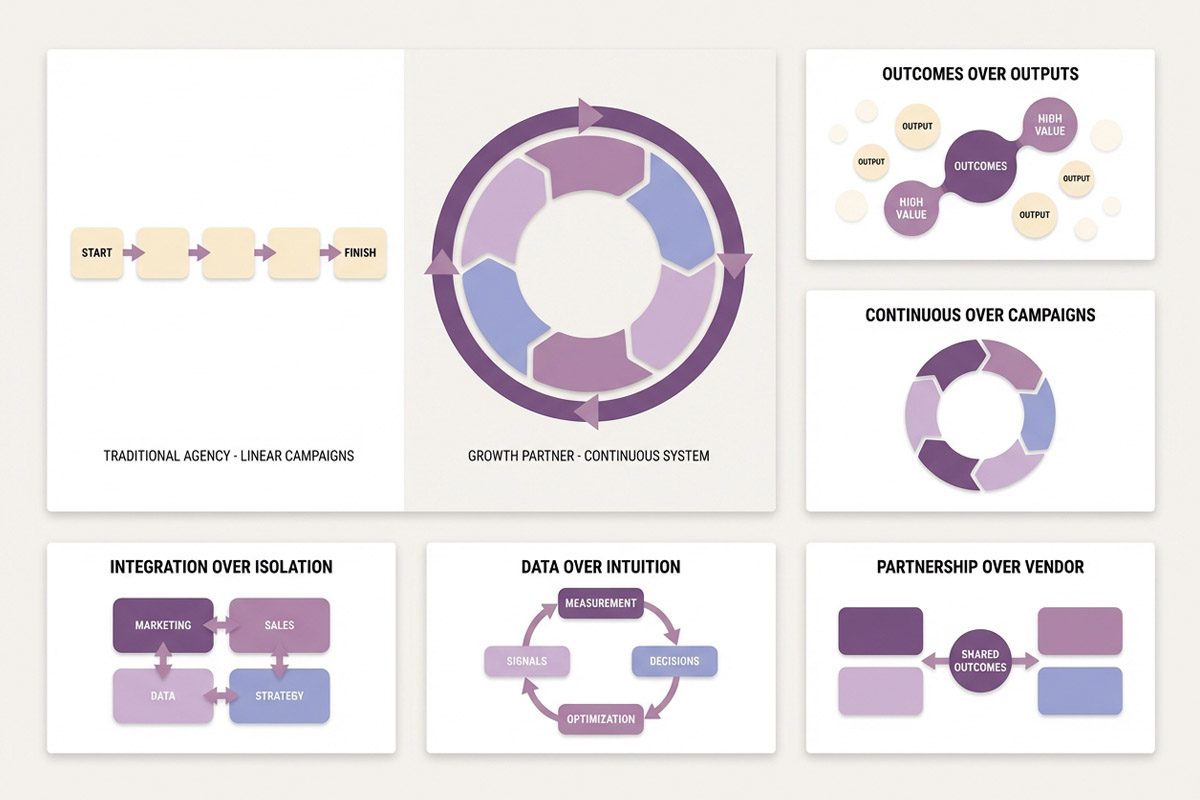
Core Principles of the Growth Partner Approach
| Principle | Description |
|---|---|
| Outcomes Over Outputs | Focus on qualified leads, deals closed, revenue — not impressions or awards |
| Continuous Over Campaigns | Always-on marketing matching extended customer journeys |
| Integration Over Isolation | Marketing embedded in business strategy with sales alignment |
| Data Over Intuition | Performance metrics guide decisions through testing and attribution |
| Partnership Over Vendor | Shared success with mutual financial stake |
We implemented these principles with a Dubai developer and produced measurable results: lead quality improved 45%, customer acquisition costs decreased 40%, and sales cycles shortened from 12 to 8 months on average.
Key Differences Between Growth Partners and Traditional Agencies
Our direct experience managing both models across 15+ years reveals stark differences affecting real estate business outcomes — not merely semantic distinctions but fundamental operational and philosophical divergences.
| Dimension | Growth Partner | Traditional Agency |
|---|---|---|
| Primary Focus | Business outcomes, revenue growth, qualified leads | Creative excellence, campaign delivery, brand awareness |
| Team Structure | Custom flexible teams (3–8 specialists based on needs) | Fixed departments (creative, media, account) |
| Measurement | Multi-dimensional KPIs: CAC, LTV, conversion rates, sales cycle | Campaign metrics: impressions, clicks, engagement, reach |
| Technology | Comprehensive stack: CRM, automation, attribution, analytics integrated | Limited tools: ad platforms, basic analytics, reporting |
| Expertise | Deep real estate specialization (3–18 month cycles, buyer journey, local markets) | Generalist approach across industries |
| Pricing | Performance-based: % of revenue, leads delivered, success fees | Hourly rates, monthly retainers, project fees |
| Timeline | Long-term partnership: 12–36 month engagements with evolving scope | Campaign-based: 3–6 month projects with defined end |
How Each Model Measures Success
Traditional Agency Metrics:
- Impressions served (millions)
- Click-through rates (percentages)
- Engagement rates (likes, shares, comments)
- Brand awareness lift (survey-based)
- Creative awards won
- Campaign completion on time/budget
Growth Partner Metrics:
- Qualified leads generated (BANT criteria met)
- Lead-to-close conversion rate (%)
- Customer acquisition cost (AED per closed deal)
- Sales cycle length (days from first touch to close)
- Revenue per campaign (AED)
- Marketing ROI (revenue ÷ spend)
- Pipeline velocity (deal flow speed)
The critical difference: traditional metrics measure activity while growth partner metrics measure business impact.
Consider this real estate example we observed: A developer working with a traditional agency celebrated 10M impressions and 2% CTR on ads — but generated only 12 qualified leads at AED 25,000 per lead. After switching to a growth partner focused on lead quality, they generated 85 qualified leads at AED 4,200 per lead, with 18% closing to sales.
Growth partner performance metrics connect marketing investments directly to revenue outcomes. If spending AED 300K monthly on marketing generates only AED 200K in attributable revenue, partner accountability drives optimization until positive ROI is achieved.
When to Choose a Growth Partner Over a Traditional Agency
Not every real estate business is ready for or requires the growth partner model. But specific challenges and growth stages signal when transition from traditional agency approaches becomes necessary.
5 Signs Your Real Estate Business Needs a Growth Partner:
- Lead Quality Crisis: Generating high lead volume but the sales team complains leads are unqualified, don’t answer calls, have no budget, or are just browsing. Traditional agencies measure success by lead quantity; growth partners accept accountability for lead quality.
- Revenue Plateau: Marketing spend increasing but revenue flat or declining. This indicates optimization gaps requiring data-driven approaches and accountability structures that growth partners provide.
- Marketing-Sales Disconnect: Sales team and marketing not aligned — leads falling through cracks, no feedback loop, conflicting priorities. Growth partners embed in business operations, facilitating integration.
- ROI Invisibility: Can’t connect marketing spend to revenue outcomes — attribution gaps, reporting doesn’t show deal source, investment decisions made blindly. Growth partners implement measurement infrastructure that creates visibility.
- Competitive Pressure: Market becoming more competitive, margins compressing, competitors launching sophisticated digital campaigns. This requires rapid optimization that traditional agency waterfall processes cannot deliver.
Evaluating Your Current Marketing Partnerships
Assessment Questions for Current Marketing Relationships:
| Evaluation Area | Key Question | Red Flag Answer |
|---|---|---|
| Accountability | Does the partner take responsibility for lead quality and conversion rates? | "We deliver campaigns as specified" |
| Integration | Is a marketing partner embedded in business strategy discussions? | "We present campaigns for approval" |
| Measurement | Can you see a direct connection between marketing spend and closed deals? | "We report on campaign metrics" |
| Responsiveness | Does a partner optimize campaigns weekly based on performance? | "We review at campaign conclusion" |
| Expertise | Does the partner demonstrate deep real estate industry knowledge? | Generic marketing speak without property specifics |
| Technology | Is the marketing stack integrated providing unified data? | Siloed tools with manual reporting |
| Pricing | Is compensation tied to performance outcomes? | Fixed fees regardless of results |
| Timeline | Is the relationship long-term with evolving scope? | Campaign-to-campaign engagements |
Red Flag Alert: If answering “no” to 5+ questions above, the current partnership is likely not optimized for business growth.
Real-World Results: Case Study
These metrics come from campaigns we directly led and advised — verified through platform analytics and client reporting, not estimates.
Case Study: Dubai Luxury Developer — Traditional Agency to Growth Partner Transition
Context: A 20-tower mixed-use development with AED 8B project value had worked with a traditional agency for 18 months, generating high impressions but suffering from poor lead quality.
Problem: The marketing generated 200-300 leads monthly, but only 8-12 qualified leads meeting BANT criteria. Customer acquisition cost reached AED 18,500 per qualified lead. The sales team expressed deep frustration with lead quality, wasting time on unqualified prospects.
Our Growth Partner Approach:
- Implemented comprehensive marketing automation with HubSpot
- Rebuilt lead scoring model based on behavioral and demographic signals
- Created educational content marketing nurturing sequence with 12 touchpoints
- Integrated CRM with marketing platform for closed-loop reporting
- Established weekly optimization meetings with sales team feedback
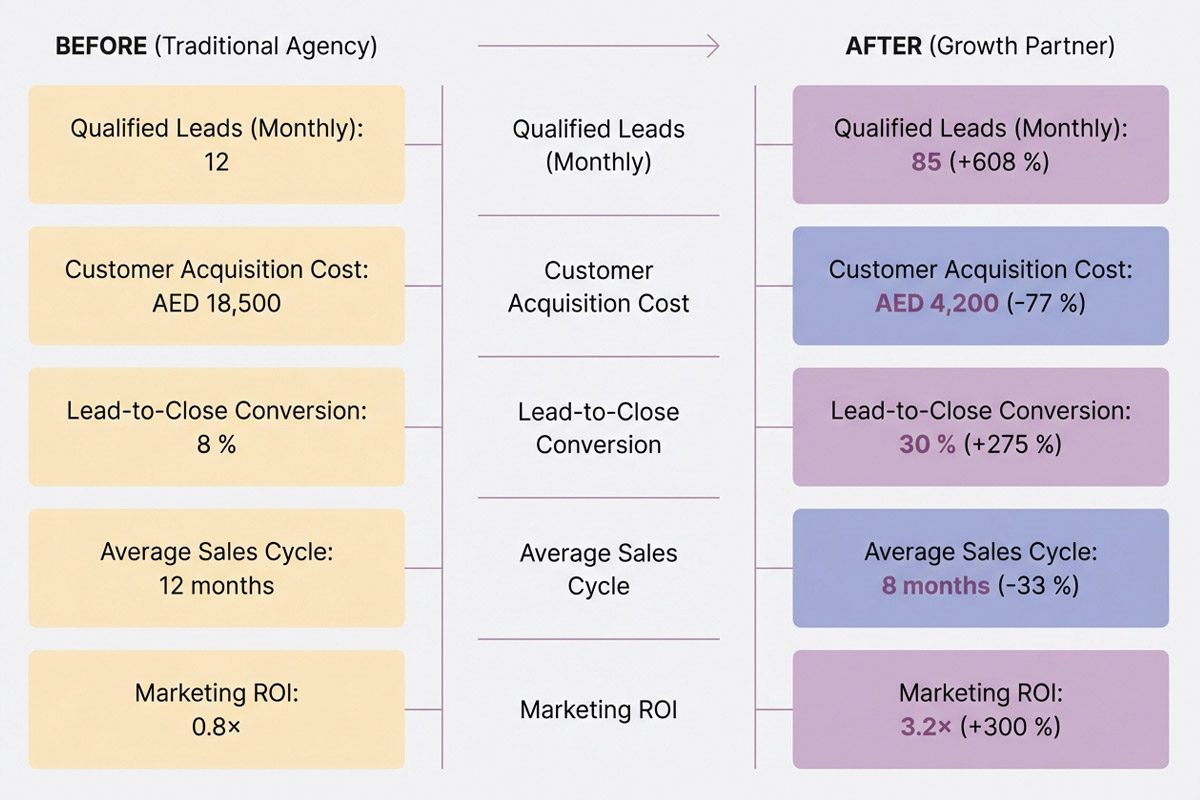
Results After 6 Months:
| Metric | Before | After | Improvement |
|---|---|---|---|
| Qualified Leads (Monthly) | 12 | 85 | +608% |
| Customer Acquisition Cost | AED 18,500 | AED 4,200 | -77% |
| Lead-to-Close Conversion | 8% | 30% | +275% |
| Average Sales Cycle | 12 months | 8 months | -33% |
| Marketing ROI | 0.8x | 3.2x | +300% |
Key Success Factors: Continuous optimization based on performance metrics, sales-marketing alignment through weekly meetings, sophisticated lead generation nurturing matching the extended buyer journey, and shared accountability for results.
For more examples of data-driven marketing results, explore Lead Craft’s case studies showcasing similar transformations across various industries.
How to Select the Right Growth Partner for Your Real Estate Business
Growth Partner Selection Process (5 Steps)
Step 1: Define Business Objectives & Marketing Needs
- Identify specific growth goals: revenue targets, lead volume requirements, market expansion, brand positioning
- Quantify current state: existing lead generation performance, customer acquisition cost, sales cycle length, marketing ROI
- Determine capability gaps: technology deficiencies, expertise shortfalls, resource constraints
Step 2: Research Potential Partners
- Evaluate real estate industry specialization — review case studies, client portfolio, years in property marketing
- Assess digital marketing technology capabilities — marketing stack expertise, integration experience, technical team depth
- Verify performance metrics orientation — measurement approach, reporting structure, accountability framework
- Check references from real estate developers — speak with 3-5 current/past clients about results and partnership quality
Step 3: Conduct Evaluation Meetings
- Request initial strategy assessment — how would partner approach your specific challenges?
- Review pricing models — performance-based vs. traditional fee structures, risk-sharing mechanisms
- Meet proposed team — verify individuals have real estate marketing expertise, not generalists
- Examine reporting examples — ensure performance metrics align with business outcomes
Step 4: Pilot Project Consideration
- Consider a 3-month pilot with defined success metrics before long-term commitment
- Test partnership dynamics: responsiveness, collaboration quality, optimization speed
- Evaluate deliverables against promises — did initial results match expectations?
Step 5: Formalize Partnership
- Negotiate a contract with clear performance metrics, reporting cadence, and scope boundaries
- Establish communication protocols, approval processes, escalation procedures
- Set quarterly business reviews for strategic alignment evaluation
Critical Questions to Ask Potential Growth Partners
10 Essential Vetting Questions:
- Real Estate Experience: “How many property developers/brokerages are in your current client portfolio? What’s your longest client relationship duration?” Strong candidates have 5+ active real estate clients and 2+ year relationships.
- Performance Accountability: “How is your compensation tied to business results? What happens if lead quality doesn’t meet agreed standards?” Seek performance-based pricing components and a clear remediation process.
- Measurement Approach: “Walk me through your attribution methodology — how do you connect marketing activities to closed deals?” Quality partners demonstrate multi-touch attribution with CRM integration.
- Technology Stack: “What marketing technology platforms do you work with? How do you integrate them?” Verify experience with HubSpot, Salesforce, Marketo, Google Analytics 4.
- Industry Expertise: “Explain the typical real estate buyer journey in our market segment and how you’d address each stage.” The right partner shows detailed understanding of 3–18 month cycles and stage-specific tactics.
- Optimization Process: “How frequently do you review campaign performance and make adjustments?” Weekly reviews minimum and rapid testing methodology are standard.
- Sales Integration: “How do you collaborate with sales teams to ensure lead quality and follow-up?” Reliable partners maintain regular meetings, feedback loops, shared dashboards.
- Case Study Specifics: “Share detailed metrics from a similar real estate client — qualified leads, CAC, conversion rates, sales cycle.” Demand specific numbers, not vague “improvements.”
- Team Composition: “Who specifically would work on our account? What’s their real estate marketing experience?” Insist on named individuals with real estate backgrounds.
- Pricing Transparency: “Provide complete cost breakdown including all fees, technology costs, media spend requirements.” Transparent itemization without hidden costs is non-negotiable.
Conclusion: Making the Right Choice for Your Real Estate Business
The growth partner vs. traditional marketing agency decision comes down to business priorities: creative excellence for brand campaigns favors traditional agencies; measurable revenue growth with accountability requires a growth partner.
Real estate marketing complexity — 3-18 month sales cycles, high-value transactions, competitive markets — increasingly favors the growth partner model’s integrated, data-driven approach.
Traditional agencies work for: single campaign needs, creative first priorities.
Growth partners work for: sustained growth focus, lead quality/ROI gaps, marketing-sales misalignment, competitive pressure.
Our experience demonstrates that real estate businesses serious about growth achieve 15-30% higher ROI through growth partners’ performance metrics focus and continuous optimization — outcomes traditional agencies structurally cannot provide.
If experiencing lead quality issues or ROI invisibility, explore Lead Craft’s data-driven marketing approach.
Frequently Asked Questions
What makes a growth partner different from a traditional marketing agency?
Growth partners provide performance-based accountability (compensation tied to lead quality and revenue), custom team structures, comprehensive data utilization (multi-touch attribution, CRM integration), and long-term partnership (12-36+ months). Traditional agencies optimize for creative excellence; growth partners optimize for measurable business outcomes with shared risk/reward.
When should a real estate business choose a growth partner?
When experiencing lead quality crisis, revenue plateau, marketing-sales disconnect, ROI invisibility, or competitive pressure. Ready businesses typically have marketing budgets AED 500K+, sales cycles 6–18 months, and commitment to data-driven accountability.
How do growth partners measure success?
Traditional agencies measure impressions, click-through rates, and brand awareness. Growth partners measure qualified leads (BANT criteria), customer acquisition cost, sales cycle length, and marketing ROI. Business outcomes are tied to revenue, not activity.
What services do growth partners offer?
Traditional agencies: creative development, media buying, campaign reporting. Growth partners: full-funnel strategy, marketing technology implementation (CRM, automation, analytics), continuous optimization, sales-marketing integration with shared KPIs.
How do growth partners integrate marketing with business strategy?
Through executive meeting participation, collaborative goal-setting, sales team alignment (shared dashboards, feedback loops), and financial transparency (CAC, LTV, ROI), transforming marketing into a strategic growth function.
 Share
Share
 X
X
 LinkedIn