






 524
524 


When businesses ask whether rich snippets help their SEO performance, the answer lies in understanding indirect ranking benefits. Rich snippets improve click – through rates by 15 – 40%, which enhances user engagement signals that search algorithms consider when evaluating content quality. These enhanced search result displays use Schema.org structured data markup to show star ratings, prices, and FAQs directly in SERPs.
The mechanism is straightforward: structured data markup (JSON – LD, Microdata, or RDFa) creates visually prominent listings that attract more clicks at existing rankings. This increased traffic, combined with improved user engagement metrics, can lead to gradual ranking improvements over time. Enterprise clients implementing rich snippets strategically see measurable traffic increases without initial ranking changes, proving the power of enhanced visibility alone.
- What Are Rich Snippets in SEO?
- How Rich Snippets Impact SEO Performance
- Implementing Rich Snippets: A Step – by – Step Guide
- Common Rich Snippet Mistakes to Avoid
- When Should You Optimize for Rich Snippets?
- How to Avoid Rich Snippet Abuse and Penalties
- Rich Snippets Tools for Implementation and Monitoring
- Rich Snippets and Future SEO Trends
- Conclusion: Are Rich Snippets Worth the Effort?
- Frequently Asked Questions
What Are Rich Snippets in SEO?
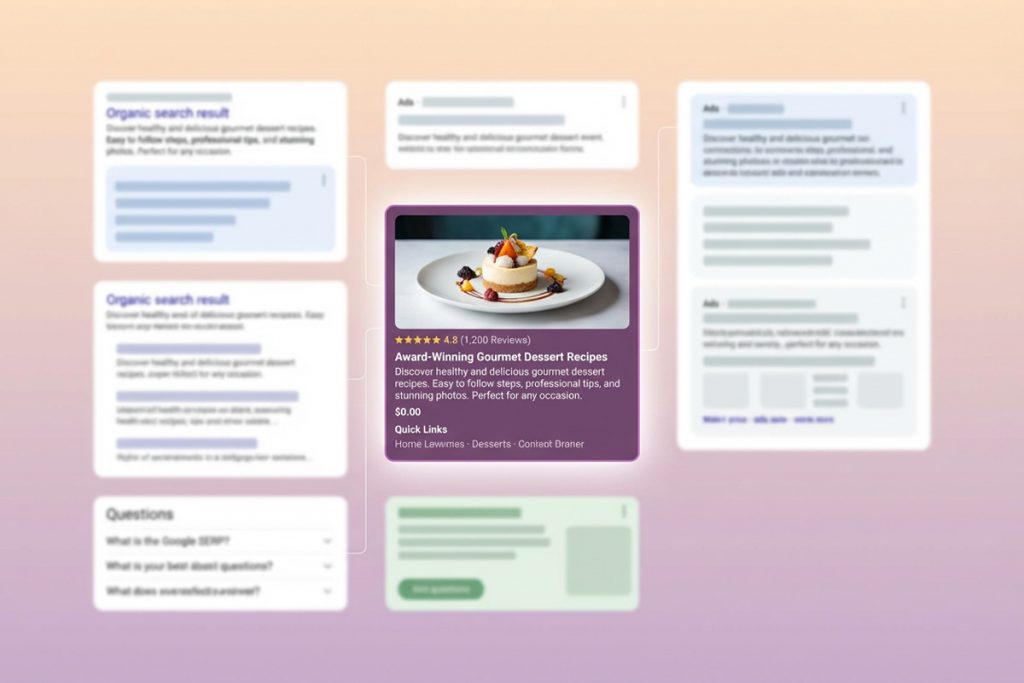
Rich snippets are enhanced search results displaying additional information beyond standard title, URL, and description – including star ratings, product prices, event dates, or FAQ answers extracted from your structured data markup.
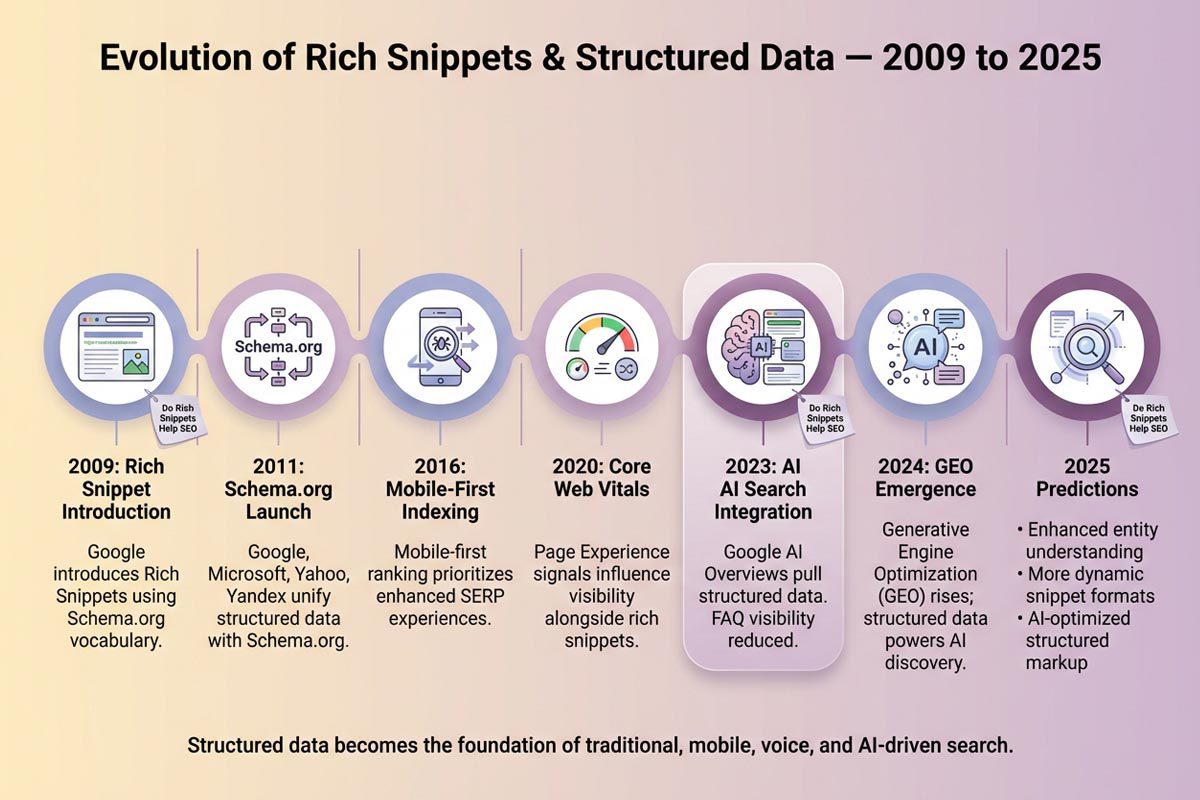
Google introduced rich snippets in 2009 using Schema.org vocabulary, a collaborative project between Google, Microsoft, Yahoo, and Yandex that now powers over 45 million domains with 450+ billion structured data objects. Schema.org structured data provides a translation layer helping search engines understand your content’s context and attributes, enabling rich visual enhancements in SERPs.
The fundamental difference between standard and rich results is information density. While traditional snippets offer only title, URL, and meta description, rich snippets pack additional context – pricing, availability, ratings, images – that helps users make informed decisions without clicking through. This pre – qualification reduces wasted clicks and improves user satisfaction.

Types of Rich Snippets Google Displays
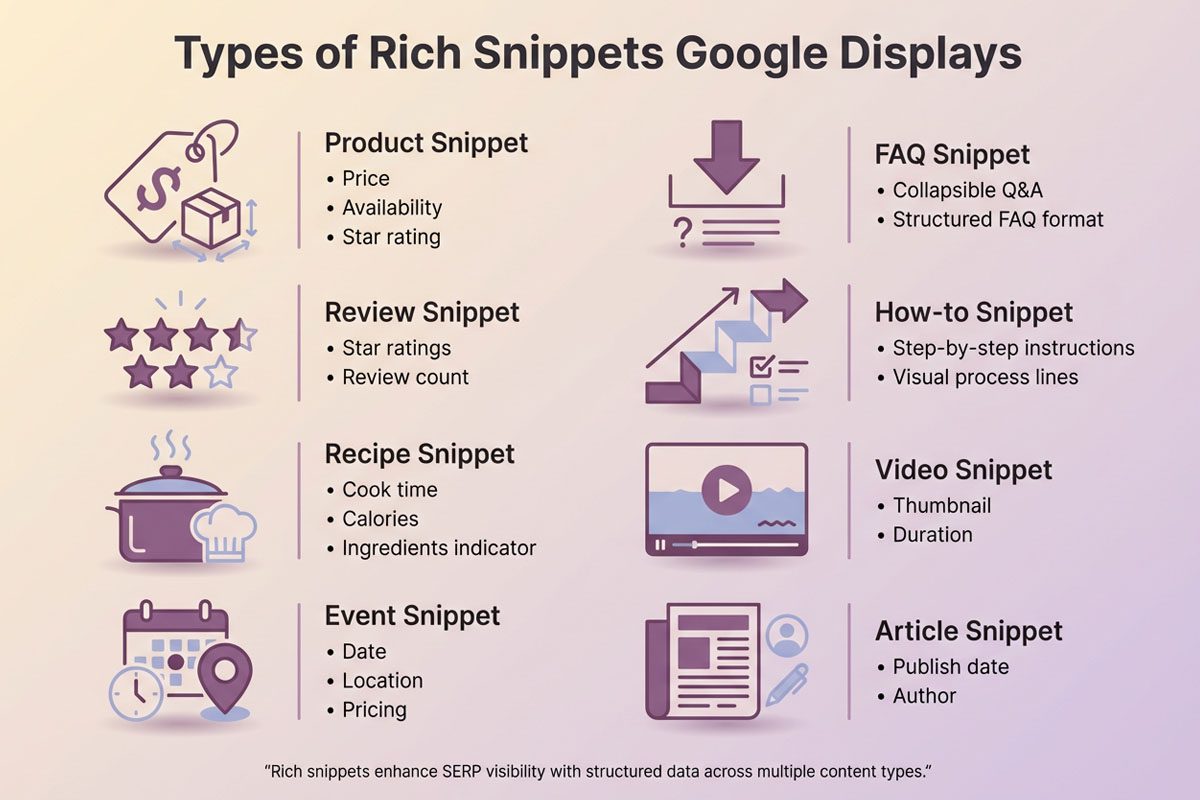
Different content types qualify for different snippet formats, each serving distinct user intents:
Review Rich Snippets display aggregate star ratings and review counts, generating 30 – 40% CTR improvements. These work for products, services, and local businesses where social proof influences decisions. The visual impact of star ratings creates immediate trust signals that standard text cannot match.
Product Rich Snippets showcase price, availability, and ratings – delivering 25 – 35% CTR increases. When shoppers see “$49.99 – In Stock – 4.5 stars,” they click with purchase intent. As of 2025, Google separates Product snippets into Merchant Listings (direct purchases) and Product Snippets (informational pages).
FAQ Rich Snippets expand results with questions and answers, generating 20 – 30% CTR improvements. However, Google reduced FAQ visibility in 2023 – 2024, showing them less frequently on mobile to prioritize AI Overviews and other features.
Additional types include:
- Recipe snippets – cooking time, calories, ratings, ingredients.
- Event snippets – date, location, pricing.
- How – to snippets – step instructions (desktop only as of 2025).
- Video snippets – thumbnail, duration.
- Article snippets – publish date, author.
- Breadcrumb snippets – site hierarchy.
Each type serves specific intents. E – commerce prioritizes Product and Review snippets. Publishers focus on Article and Video. Local businesses emphasize Review and LocalBusiness markup.
Rich Snippets vs. Featured Snippets and Rich Results
The terminology confuses many, so here’s the distinction:
Rich snippets are enhanced organic listings displaying additional information from your structured data. You control their appearance by implementing proper schema.
Featured snippets occupy “position zero” above results, displaying content Google algorithmically selects. You cannot control selection, and they don’t require structured data, though proper formatting helps. Featured snippets capture approximately 67% of total click share.
Rich results is Google’s umbrella term encompassing all enhanced features, including rich snippets, knowledge panels, and carousels.
| Feature | Implementation Control | Markup Required | SERP Position | Key Benefit |
|---|---|---|---|---|
| Rich Snippets | High – you control via schema | Yes – structured data | Normal organic positions | 15 – 40% CTR increase |
| Featured Snippets | Low – Google selects algorithmically | No | Position zero | ~67% click share |
| Rich Results | Varies by type | Usually yes | Varies | Enhanced visibility |
How Rich Snippets Impact SEO Performance
Rich snippets create indirect SEO benefits through enhanced visibility driving higher click – through rates, which generate positive user engagement signals that search algorithms consider when ranking content.
Rich snippets are NOT a direct ranking factor. Google has confirmed that structured data doesn’t directly influence rankings. Your page won’t jump positions simply because you added schema markup. The real value emerges through the engagement cascade: enhanced listings attract attention → higher CTR → engaged visitors → improved behavioral metrics → potential ranking improvements.
A SaaS client saw organic traffic increase 37% within three months of implementing Product and Review snippets – not from ranking changes, but because CTR jumped from 2.8% to 4.1% at existing positions. This demonstrates how visibility enhancements alone can dramatically increase traffic without any ranking movement.

Rich Snippets and CTR: The Connection
Research analyzing over 4.5 million queries reveals rich results generate 58% CTR compared to 41% for standard results – a 17 – percentage – point difference that translates to significant traffic gains.
Key factors driving this increase:
- Visual prominence – Rich snippets consume more SERP real estate with ratings and additional information, catching attention more effectively than plain blue links in competitive search results.
- Pre – qualification – Users gather essential information before clicking. A 5 – star rating with 243 reviews signals quality, reducing bounce rates because visitors know what to expect.
- Trust signals – Star ratings provide social proof directly in search results, making users more likely to choose your result over competitors lacking these visual indicators.
- Decision efficiency – Rich snippets eliminate guesswork. Users can compare prices, check availability, and assess quality without opening multiple tabs, streamlining their decision – making process.
| SERP Position | Standard Result CTR | Rich Snippet CTR | Improvement |
|---|---|---|---|
| Position 1 | ~30% | 39 – 42% | +9 – 12 points |
| Position 2 | ~15% | 20 – 22% | +5 – 7 points |
| Position 3 | ~10% | 13 – 15% | +3 – 5 points |
| Position 4 – 5 | ~5 – 7% | 7 – 10% | +2 – 3 points |
A site generating 100,000 monthly impressions at position 2 with 15% CTR gets 15,000 clicks. Implement rich snippets, boost CTR to 22%, and you receive 22,000 clicks – a 7,000 – click increase without ranking changes.
Indirect Benefits for Search Rankings
Search algorithms evaluate user engagement signals as quality indicators. While Google doesn’t explicitly confirm weights, patents and statements indicate user interactions influence rankings.
Rich snippets improve engagement through: higher CTR signaling relevance, lower bounce rates from pre – qualified visitors, increased dwell time when expectations match content, and repeat visits from satisfied users.
These improvements create compounding effects: Better CTR → more traffic → improved engagement → stronger quality signals → potential ranking improvements → more visibility → even better CTR.
These benefits emerge gradually – meaningful ranking improvements typically surface 8 – 12 weeks after implementation, assuming solid content quality and technical foundation.

Implementing Rich Snippets: A Step – by – Step Guide
Implementation requires technical precision but follows a clear workflow:
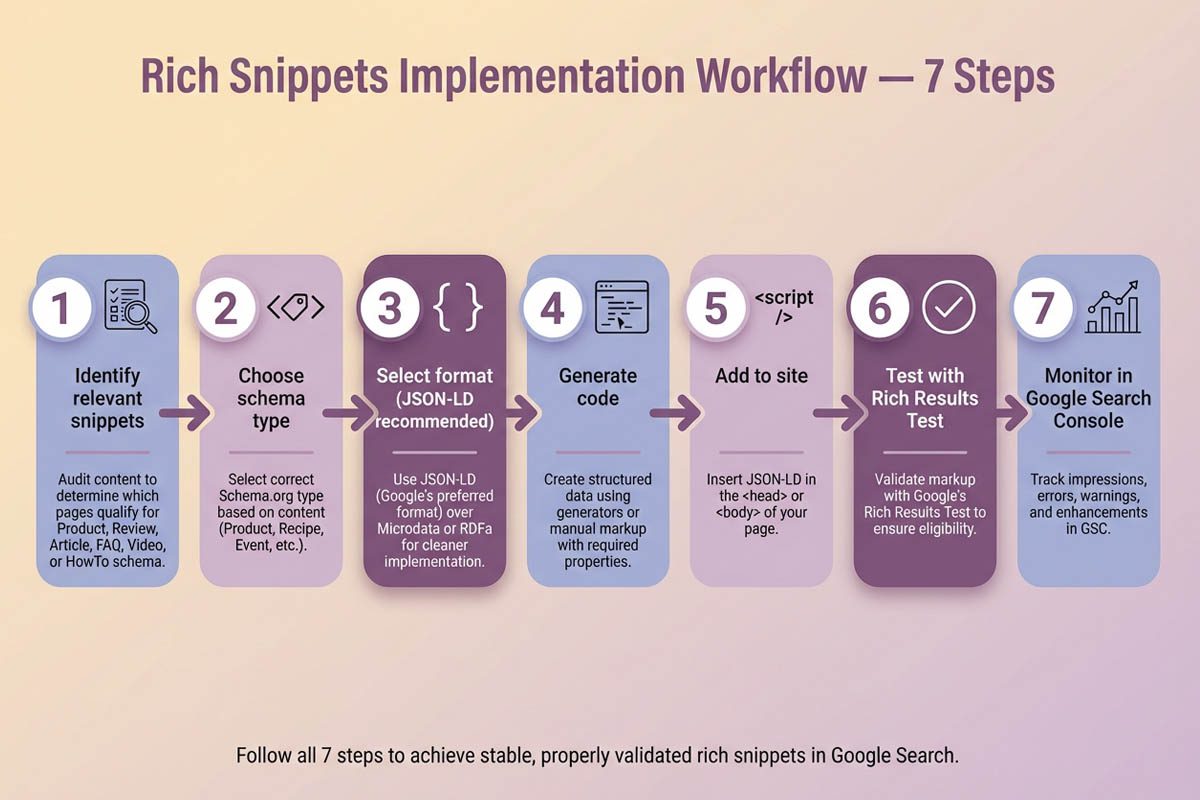
Step 1: Identify opportunities – Audit content to determine which pages qualify. E – commerce prioritizes Product schema, service businesses emphasize Review markup, publishers focus on Article and Video schemas.
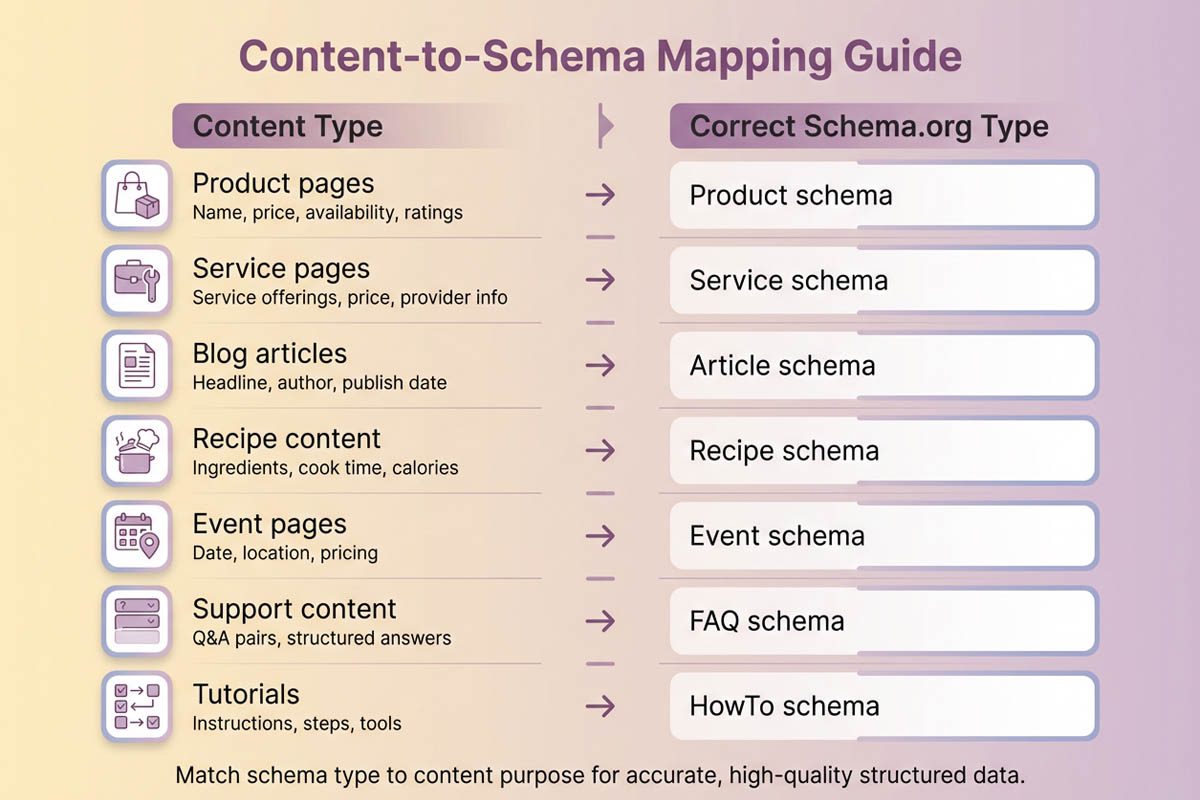
Step 2: Choose schema types – Schema.org provides 800+ types, but most sites need fewer than 10. Match schema to content: Product for products, Recipe for recipes, Event for events.
Step 3: Select format – Three formats exist, but Google recommends JSON – LD for ease of implementation.
Step 4: Generate code – Use schema generators or create markup manually with essential properties defined.
Step 5: Add markup – Insert JSON – LD script tags in page <head> or <body>.
Step 6: Validate – Test using Google’s Rich Results Test before deployment.
Step 7: Monitor – Track performance through Google Search Console’s Enhancements reports for errors and impression data.
Understanding Structured Data Formats
Three formats exist with distinct characteristics:
JSON – LD (JavaScript Object Notation for Linked Data) – Google’s recommended format and industry standard. Uses standalone script tags separate from HTML, making implementation cleaner and maintenance easier.
Example JSON – LD Product markup:
<script type=”application/ld+json”>
{
“@context”: “https://schema.org/”,
“@type”: “Product”,
“name”: “Enterprise SEO Platform”,
“image”: “https://example.com/product – image.jpg”,
“description”: “Complete SEO solution for large – scale websites”,
“brand”: {
“@type”: “Brand”,
“name”: “Lead Craft”
},
“offers”: {
“@type”: “Offer”,
“price”: “299.00”,
“priceCurrency”: “USD”,
“availability”: “https://schema.org/InStock”
},
“aggregateRating”: {
“@type”: “AggregateRating”,
“ratingValue”: “4.7”,
“reviewCount”: “143”
}
}
</script>
Microdata integrates markup into HTML elements using itemscope, itemtype, and itemprop attributes. This wraps existing content but increases HTML complexity.
RDFa extends HTML with additional attributes. Less common than JSON – LD or Microdata.
| Format | Ease of Implementation | Google Preference | HTML Separation | Best Use Case |
|---|---|---|---|---|
| JSON – LD | High – standalone script | Officially recommended | Complete separation | Most sites, especially at scale |
| Microdata | Medium – integrated with HTML | Supported | No separation | Sites needing explicit content – markup links |
| RDFa | Lower – more complex | Supported | No separation | Sites already using RDFa |
The structured data foundation enabling rich snippets also powers AI search visibility. Lead Craft’s generative engine optimization builds upon Schema.org markup to ensure content appears in ChatGPT, Perplexity, and Gemini responses – expanding beyond traditional SERPs into AI – powered search.
Choosing the Right Schema Markup for Your Content
Match content type to appropriate markup:
E – commerce sites:
- Product pages → Product schema (name, price, availability, ratings)
- Category pages → ItemList schema
- Review pages → Review and AggregateRating schema
Service businesses:
- Service pages → Service schema with offers
- About page → Organization schema
- Location pages → LocalBusiness schema
Content publishers:
- Blog posts → Article schema
- Videos → VideoObject schema
- Tutorials → HowTo schema
Information sites:
- FAQ pages → FAQPage schema
- Event listings → Event schema
- Recipes → Recipe schema
Implement multiple schemas on single pages when relevant – a product page might include Product, AggregateRating, and FAQPage schemas. Ensure each accurately represents visible content.
Common Rich Snippet Mistakes to Avoid
Google Search Console’s Enhancement reports identify implementation errors:
Incorrect property values – Wrong data types, invalid URLs, or incorrect enumerations. Example: setting availability to “yes” instead of “https://schema.org/InStock”.
Missing required properties – Each schema defines required properties. Product requires name, image, and offers.
Marking invisible content – Adding markup for information users can’t see violates guidelines.
Conflicting markup types – Multiple contradictory schemas confuse search engines.
Outdated schema versions – Schema.org evolves quarterly; deprecated properties may fail.
Ignoring validation warnings – Fix non – critical warnings to improve markup quality.
Marking irrelevant content – Schema must accurately represent page content.
Failing to update markup – Update structured data when content changes.
Errors to avoid:
- ❌ Incorrect property values
- ❌ Missing required properties
- ❌ Marking invisible content
- ❌ Conflicting markup types
- ❌ Ignoring test warnings
- ❌ Outdated schema versions
- ❌ Marking irrelevant content
- ❌ Failing to update markup
When Should You Optimize for Rich Snippets?
Strategic prioritization focuses on highest – ROI opportunities:
High – converting product pages – E – commerce pages generating significant revenue benefit immediately from Product and Review snippets.
Top – performing content ranking positions 1 – 5 – CTR improvements matter most with existing page – one visibility.
Competitive keyword targets – Rich snippets create differentiation when multiple competitors vie for clicks.
Pages with unique data or assets – Recipe sites with nutrition information, event sites with schedules, or product sites with specifications showcase this directly in SERPs.
High – volume question content – Comprehensive FAQ pages naturally suit FAQ schema, expanding SERP presence.
Priority ranking:
- 🔥🔥🔥 High – converting product pages
- 🔥🔥🔥 Popular blog posts ranking #1 – 5
- 🔥🔥 Key service pages
- 🔥🔥 Competitive keyword targets
- 🔥🔥 Pages with unique visual/data assets
- 🔥🔥 High – volume question content
Start with highest – impact opportunities, measure results, then expand systematically.
How to Avoid Rich Snippet Abuse and Penalties
Google’s guidelines are explicit about prohibited practices:
Marking content not visible to users – All marked – up content must be visible and accessible.
Creating fake reviews – Fabricating reviews or marking testimonials as independent reviews violates guidelines. As of 2025, Google strengthened requirements, recommending reviewer names and written comments.
Using irrelevant markup – Schema must accurately represent primary content.
Falsifying information – Marking products “In Stock” when unavailable misleads users.
Structured data for manipulation – Using markup solely for SERP advantages without genuine user value risks penalties.
Google prohibits:
- ⚠️ Marking up invisible content
- ⚠️ Using irrelevant markup
- ⚠️ Creating fake reviews
- ⚠️ Falsifying information
- ⚠️ Structured data purely for manipulation
Penalties range from snippet removal to site – wide deindexing. Ethical implementation is straightforward: mark up only visible, accurate content that genuinely helps users.
Rich Snippets Tools for Implementation and Monitoring
Essential tools streamline implementation:
Google’s Rich Results Test – Pre – deployment validation checking rich result eligibility. Identifies errors and shows supported types.
Schema Markup Validator – Generic validator ensuring Schema.org specification compliance.
Google Search Console – Post – deployment monitoring showing indexing status. Enhancements section displays valid items, errors, warnings, and impressions.
Schema markup generators – Generate structured data from forms, though auto – generated code requires validation.
WordPress schema plugins – Yoast SEO, Rank Math, or Schema Pro simplify implementation through interfaces.
Tool recommendations:
- Google’s Rich Results Test (pre – deployment validation)
- Schema Markup Validator (syntax checking)
- Google Search Console (performance monitoring)
- Schema markup generators (code creation)
- WordPress schema plugins (CMS integration)
- Structured data monitoring services (ongoing tracking)
Rich Snippets and Future SEO Trends
Structured data’s importance extends into emerging technologies reshaping search behavior:
Voice search optimization relies on structured data for quick answers. As voice search grows, with 35% of searches voice – activated, structured data becomes critical for appearing in voice results across Alexa, Google Assistant, and Siri.
AI search engines use structured data as primary sources. Google’s AI Overviews appear in 15% of searches, pulling from structured data. ChatGPT and Perplexity also leverage Schema.org markup for factual information and entity extraction.
Mobile – first indexing prioritizes mobile experiences where rich snippets provide more value on limited screens. With mobile searches exceeding desktop, enhanced listings become increasingly important for capturing mobile user attention.
Schema.org evolution continues with quarterly updates adding new types and properties for emerging content formats and use cases.
Reduced snippet diversity – Google retired seven types in 2025 including Book Actions, Course Info, and Special Announcement, focusing on widely – used features that deliver clear user value.
Enhanced quality requirements – Google emphasizes transparency. Review snippets require reviewer names and comments. All markup must accurately represent visible content, with stricter validation against manipulation attempts.
Structured data becomes more important as search diversifies across platforms and AI tools. Businesses implementing comprehensive structured data now position for visibility across traditional search, voice assistants, and AI – generated responses.
Conclusion: Are Rich Snippets Worth the Effort?
Absolutely – with a strategic approach. Rich snippets deliver measurable 15 – 40% CTR improvements, enhance user experience through pre – qualification, and create compounding engagement benefits that indirectly influence rankings.
Implementation effort is moderate. Initial deployment takes 10 – 20 hours depending on complexity. Ongoing maintenance requires minimal effort once systems are established.
ROI calculation is straightforward. With 50,000 monthly impressions at 3% CTR, you receive 1,500 clicks. Boost to 4.2% through rich snippets, and you receive 2,100 clicks – a 600 – click monthly increase without ranking improvements.
Key takeaways:
- ✅ Rich snippets help SEO indirectly through engagement
- 📊 15 – 40% average CTR improvement
- ⚙️ Moderate effort with high ROI
- 🎯 Not a direct ranking factor
- 💡 Prioritize high – value pages
- 🔍 Essential for competitive SERPs
- 🤖 Foundation for AI search (GEO)
Start with highest – converting pages or competitive keywords. Implement validated structured data. Monitor through Google Search Console. Expand based on results. Benefits emerge gradually but deliver lasting advantages in crowded search results.
Frequently Asked Questions
Do rich snippets help SEO?
Yes, rich snippets help SEO indirectly by improving CTR 15 – 40%, generating positive user engagement signals that search algorithms consider. Not a direct ranking factor, but improved engagement creates compounding benefits including better behavioral metrics and potential ranking improvements.
What are rich snippets?
Enhanced search results displaying additional information beyond title, URL, and description – including star ratings, prices, availability, images, FAQ answers, or event details extracted from Schema.org structured data markup.
Which types of rich snippets have the biggest impact on SEO?
Review snippets show highest CTR impact at 30 – 40%, followed by product snippets at 25 – 35%, and FAQ snippets at 20 – 30%. Effectiveness varies by industry – e – commerce sees stronger product benefits while service businesses gain more from review markup.
What is schema markup?
Structured data vocabulary created by Google, Microsoft, Yahoo, and Yandex helping search engines understand page content. Enables rich snippets by providing standardized, machine – readable descriptions using formats like JSON – LD.
How to check if rich snippets are working correctly?
Use Google’s Rich Results Test for pre – deployment validation and Google Search Console’s Enhancements reports for ongoing monitoring. Rich Results Test identifies errors and previews snippets. Search Console shows valid items, errors, and impressions.
When should you optimize for rich snippets?
Prioritize high – converting pages, content ranking positions 1 – 5, competitive keywords where differentiation matters, and pages with unique data worth showcasing. Focus on highest ROI opportunities first, measure results, expand systematically.

“Clean Work”: Boosting Traffic and Leads for a Cleaning Service
- Theme B2C aggregator of cleaning services
- Goal Increase traffic and receive requests from the search
- Service Comprehensive SEO promotion
- Result 3 times higher traffic


Auto Loan Broker: Reaching the Top and Achieving 9x Traffic Growth
- Theme Finance
- Goal Organic traffic growth
- Service SEO promotion
- Result Traffic growth by 9 times


GOSU.AI: 400,000 Blog Visitors in One Year
- Theme Gaming
- Goal Increased traffic
- Service SEO promotion
- Result 400,000 visitors from organic traffic


Healthcare in the US: Growth to 350,000 Visits per Month
- Theme Healthcare
- Goal Increase traffic 5 times
- Service SEO promotion
- Result 350,000 sessions per month
 Share
Share
 X
X
 LinkedIn